

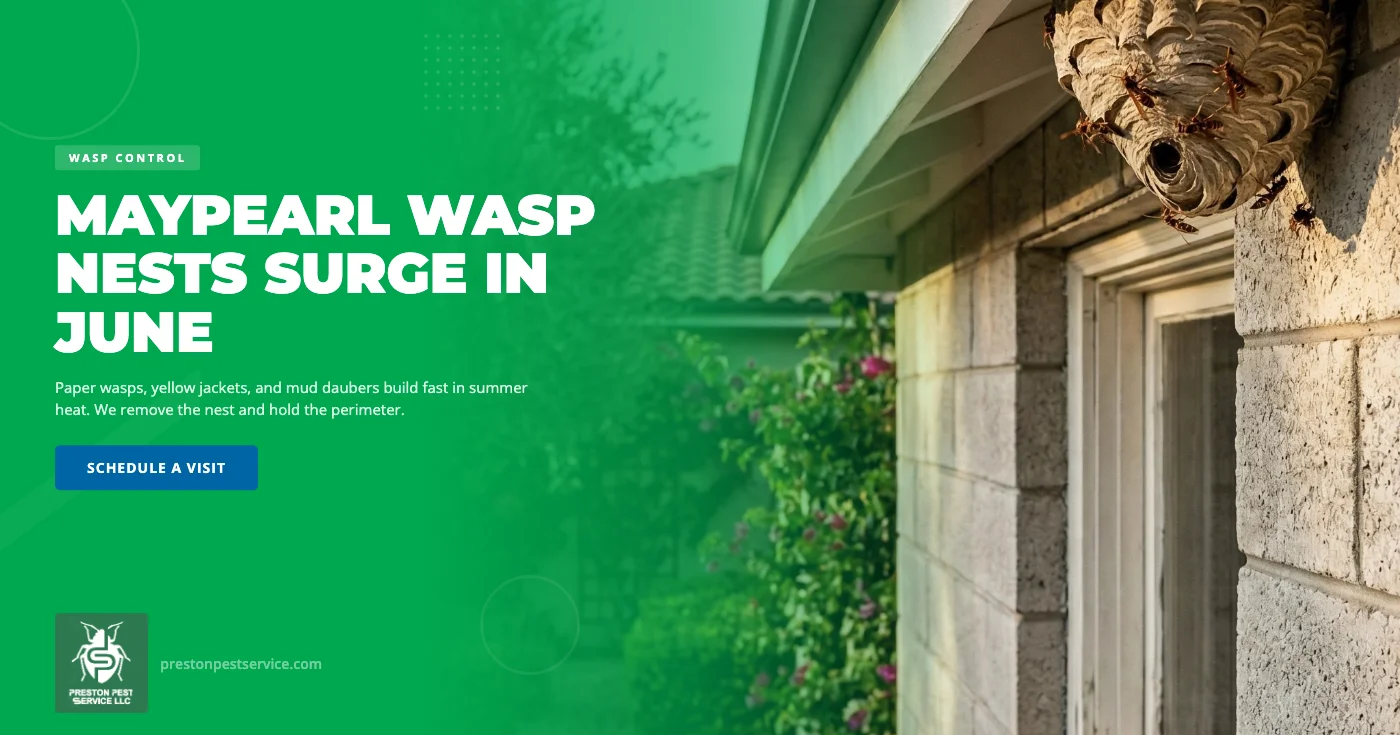
Wasps go from background nuisance to daily hazard in Maypearl, TX once June heat sets in. Paper wasp nests that started under the eaves in April are now fist-sized colonies of fifty workers, yellow jackets are tucked into fresh underground nests in the lawn, and mud dauber tubes are appearing on the shed wall almost overnight. For dependable wasp control Maypearl TX homeowners trust, Preston Pest Service brings the eave inspection, targeted nest removal, and residual perimeter that gets the back patio back before the worst of summer lands.
This guide walks through why mid-summer is the worst stretch for wasp pressure in Ellis County, the three species we see most often around Maypearl homes, where nests hide on the property, the real risk of trying to knock one down in July heat, and the prevention steps every homeowner should run.
Why Maypearl Wasp Activity Peaks in Mid-Summer
Wasp calls climb every spring across Maypearl, but the true peak lands in the back half of June and runs through August. Three local conditions stack together to make our stretch of Ellis County one of the worst pockets in North Texas for summer wasp pressure.
First, the colony cycle hits its inflection point in early summer. A paper wasp nest started by a single overwintering queen in April is barely the size of a quarter through May. By the third week of June, that same nest is the size of a softball with thirty to fifty workers defending it. Yellow jacket colonies follow the same curve only steeper — what was a basketball-sized underground nest in May can hold a thousand workers by July.
Second, daytime highs above 95°F push wasps into longer foraging windows. They hunt earlier and stay out later to chase caterpillars, flies, and other protein sources for the growing colony. That foraging brings them onto the patio, around the grill, and into the playset.
Third, Maypearl yards sit close to pastureland, hayed fields, and creek bottoms — habitat that supports both ground-nesting yellow jackets and the prey base the whole local wasp population depends on.
Yellow Jackets, Paper Wasps, and Mud Daubers: What's Active in June
By mid-June, three species drive almost every wasp call we get from Maypearl homeowners. Knowing which one is on the property changes both the urgency and the right way to handle it.
Paper wasps are the species homeowners encounter most often around Ellis County homes. They build open-faced, umbrella-shaped nests from chewed wood fiber, hanging from a single stalk under eaves, in shed rafters, inside light fixtures, and along porch ceilings. Adults are reddish-brown to dark with yellow markings, about an inch long with long dangling legs in flight. A paper wasp colony peaks at fifty to two hundred workers and defends the nest aggressively when disturbed within a few feet.
Yellow jackets are the species we worry about most in summer. They're shorter and stockier than paper wasps, hairless, with bright yellow and black banding. The bulk of yellow jacket nests in our area are subterranean — built inside abandoned rodent burrows, hollow tree bases, and gaps along foundations — and the entrance hole is often the only sign of a colony underneath. According to the Texas Apiary Inspection Service at Texas A&M, a mature yellow jacket nest can house several thousand workers by late summer, sting repeatedly, and recruit defenders in response to ground vibration. They are the highest-risk wasp encounter for North Texas homeowners.
Mud daubers are the long, thin, often metallic-blue or black wasps that build the finger-shaped mud tubes on shed walls, soffits, and garage doors. They're solitary, rarely sting unless handled roughly, and provision their nests with paralyzed spiders. Aesthetic problem, not a health problem — but their old tubes attract carpenter bees and other secondary nesters once they're abandoned.
Where Wasps Build Nests Around Maypearl Homes
Wasps reuse the same sheltered, vibration-quiet spots on a property year after year. When our team walks a Maypearl yard for a June inspection, these are the locations we check first.
- Eaves and soffits. The single most common paper wasp site — the underside of the overhang gives the colony cover from rain and direct sun. Re-check both the front and back of the house and every gable corner.
- Porch ceilings and patio covers. Tongue-and-groove ceilings, beadboard, and pergola crossbeams collect paper wasp nests every summer.
- Light fixtures and door wreaths. Wall-mount carriage lights, garage coach lights, and decorative wreaths trap heat and shelter — paper wasp magnets in June.
- Shed rafters, barn lofts, and detached garages. Outbuildings get fewer disturbances, which is exactly what a queen looks for in April.
- Underground rodent burrows and foundation gaps. Yellow jacket entry holes are easy to miss. Look for a steady stream of striped wasps coming and going from a quarter-sized hole in the lawn, flowerbed, or against the foundation slab.
- Tree cavities and hollow stumps. Mature pecans and live oaks develop rot pockets that yellow jackets readily colonize.
- Playsets and kids' equipment. Underneath swing seats, inside slide tunnels, and behind plastic panels — the worst possible location for a stinging colony.
- Mailboxes and gas grill housings. Quiet, sheltered, rarely opened until someone reaches in.
The Risk of DIY Nest Removal in Summer Heat
Knocking a wasp nest down sounds simple. In June and July, it is the moment most stinging incidents in Maypearl happen.
The mechanical problem is colony size. The same nest that one canister of foam handled in early May contains five times the workers by late June. Stay-back range goes from three feet to ten, and a panicked retreat off a wall ladder is how most homeowner ER visits start. Yellow jackets compound the risk — a mower wheel or string trimmer over a subterranean nest triggers every worker at once. Multiple stings are the common outcome, not the rare one.
The chemistry is also working against the homeowner. Off-the-shelf wasp foams drop the workers on the nest face but never penetrate inside the comb where the rest of the colony shelters. Surviving wasps return within an hour and rebuild within a foot of where the nest hung. Big-box pyrethroid sprays break down within a day in direct Texas sun. Boiling water poured into a yellow jacket hole rarely reaches the brood chamber and almost always sends defenders up the homeowner's pant leg.
The risk is medical, too. According to NIOSH guidance from the CDC, people allergic to wasp venom can experience a severe reaction or anaphylaxis after a single sting. For any household with a prior reaction history, DIY removal in July is not the right call.
Yard and Eave Inspection Tips Every Maypearl Homeowner Should Run
Before our team arrives, a simple walk-around finds 80% of the nests on a property and gives the homeowner a head start on prevention.
- Inspect at dusk, not midday. Foraging wasps return to the nest at sunset, so quiet eaves in the afternoon may still hide an active colony — wait until the sky reds out and you'll see the traffic.
- Walk every eave and soffit on a slow loop. Use a flashlight pointed up under the overhang. Look for the umbrella shape, the single stalk, and a cluster of hexagon cells.
- Check every light fixture and wreath before opening it. Pull doors slowly. Hold the porch light by the base, not the shade.
- Scan the lawn and beds for ground traffic. A steady inbound-outbound stream of striped wasps at a quarter-sized hole means a yellow jacket nest below. Mark the spot from a distance — never probe it.
- Look behind playset panels and inside slide tunnels. Brush the underside of swing seats and patio furniture cushions before letting kids use them.
- Check every shed, barn, and detached garage rafter weekly. Paper wasp colonies in outbuildings grow fastest because nobody disturbs them.
- Photograph what you find. Pictures help our technician hit the right elevation on the first ladder placement.
How Professional Wasp Control Protects Your Property Through Summer
Our wasp control program for Maypearl, TX is built around three steps — inspection, targeted removal, and residual perimeter — repeated on a cadence that holds through peak season.
The visit starts with a full property walk: eaves, soffits, porch ceilings, light fixtures, playsets, shed rafters, fence corners, foundation gaps, and the lawn line. We mark every active colony and every old nest worth scraping clean. Identification matters here — paper wasp, yellow jacket, mud dauber, cicada killer, and bald-faced hornet each take a different treatment approach.
Treatment uses a labeled residual insecticide dusted or injected at the nest entrance, then a follow-up application to the comb after activity stops. For subterranean yellow jacket nests, we treat the entry at dawn or dusk when foragers are inside, then return forty-eight hours later to confirm the colony is down before sealing the hole. A perimeter band of residual along eaves, fence lines, and patio undersides discourages new queens from settling.
Follow-up matters as much as the first visit. New queens establish nests through August, so monthly visits hold the property clear from the first treatment all the way into fall.
Frequently Asked Questions About Wasp Control in Maypearl, TX
How long does professional wasp treatment last in Maypearl, TX?
A targeted nest removal stops that colony within twenty-four to forty-eight hours. The residual perimeter we apply alongside the removal continues working for four to six weeks under typical Maypearl summer conditions. Monthly visits through June, July, and August keep new colonies from re-establishing on the eaves and in the lawn.
Is professional wasp control gentle around pets and children?
Yes. We use EPA-registered products applied directly into nests and as a band along eaves and fence lines, not broadcast across the lawn or patio surfaces. Once the application has dried — typically thirty to sixty minutes — pets and children can return to the yard.
How much does wasp nest removal cost in Maypearl, TX?
Cost depends on the species, the location, and the height of the nest. A single eave-level paper wasp removal during a routine visit is straightforward. A subterranean yellow jacket colony, a hornet nest twenty feet up a pecan, or a colony inside a soffit cavity takes more work. We quote every job during the inspection so the homeowner sees the price before treatment starts.
Why are there so many wasps in June in Texas?
Two reasons. Paper wasp and yellow jacket colonies started by a single queen in April reach fifty to several hundred workers by mid-June, which suddenly multiplies the visible activity. And the heat pushes more foraging — adults hunt prey for the growing colony from sunup to sunset.
Can I knock down a paper wasp nest myself?
A small, recently-built nest with five or fewer workers can be handled with a long-reach wasp spray at dawn or dusk, when the colony is clustered on the comb. Anything larger than a golf ball, anything above shoulder height, or anything underground belongs to a licensed pro — the sting risk in summer heat is not worth a ladder fall or an allergic reaction.
Why Preston Pest Service Is the Right Call for Maypearl Homeowners
Wasps are the summer pest most likely to turn a Maypearl backyard into a no-go zone, and every week of delay turns into bigger nests, harder removals, and more foragers around the grill. Preston Pest Service brings the inspection, the targeted nest treatment, and the perimeter residual that finally gives Maypearl families their patios back through summer. Our residential pest control program keeps wasps, ants, spiders, and other seasonal pests under one recurring plan.
We serve Maypearl, Venus, Midlothian, Waxahachie, Italy, Grandview, Alvarado, Glenn Heights, Red Oak, Ovilla, and surrounding Ellis and Johnson County communities, and have earned a 5.0-star rating across more than 200 reviews. If a nest just appeared under the eave, the lawn has a yellow jacket hole, or anyone in the family has a sting allergy history, the time to schedule is now. Contact us today to book your Maypearl wasp control visit.


