

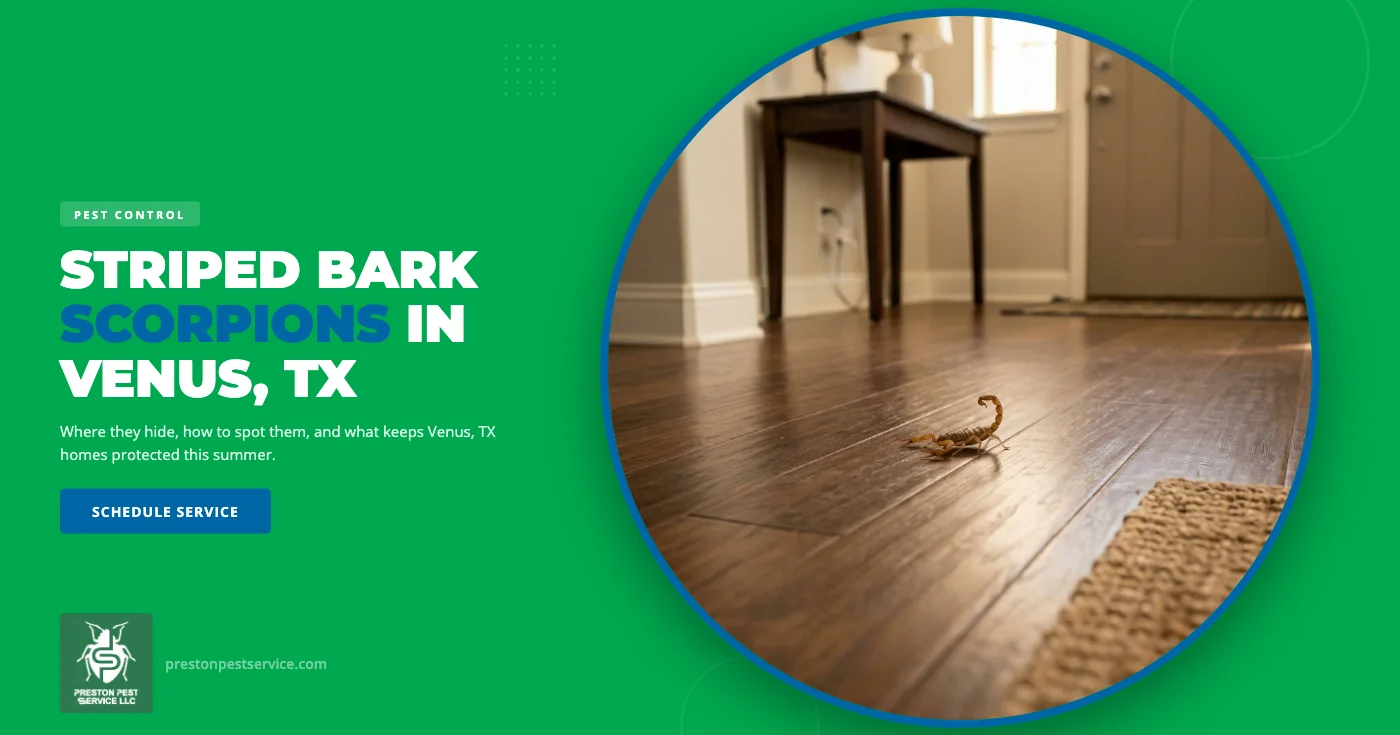
The striped bark scorpion is the species behind almost every scorpion call we run across Ellis County. It's the most widespread scorpion in Texas, the one homeowners in Venus find inside shoes and along baseboards in July, and the species that's most likely to wander indoors during the long stretches of summer heat. The species itself isn't aggressive, and the sting — while painful — is generally not medically serious for healthy adults. But the discomfort, the unpredictability of indoor encounters, and the genuine risk to small children, older family members, and people with allergies make scorpion control in Venus, TX a summer priority for a lot of households. At Preston Pest Service, we work scorpion calls across Venus, Midlothian, Maypearl, Waxahachie, and the rest of Ellis County, and the patterns are consistent enough year to year that the same prevention steps work on most properties. This guide covers whether striped bark scorpions are common in Venus, how to identify them, where they hide in Texas homes, and what actually keeps them outside.
Are Striped Bark Scorpions Common in Venus, TX and Ellis County?
Yes. The striped bark scorpion (Centruroides vittatus) is the most common and widely distributed scorpion species in Texas, with confirmed populations across all 254 counties according to Texas A&M AgriLife Extension. Ellis County sits squarely in that range, and the Blackland Prairie soils south of the Dallas-Fort Worth metroplex give them the rock outcrops, leaf litter, fence-line cover, and outbuildings they need. Venus's mix of older homes, newer subdivisions on previously rural land, and properties with hay fields, livestock structures, and decorative rock landscaping pretty well covers every habitat type striped bark scorpions favor.
Activity is strongly seasonal. They begin emerging from overwintering harborage in March as nighttime temperatures climb, become highly active April through October, and peak in encounter frequency from late May through August. Hot, dry Central Texas summers push them indoors looking for cooler shelter and water — Texas Monthly's coverage of Texas scorpion season notes that bathrooms, kitchens, and utility rooms become the most common indoor encounter spots once drought stress sets in. That timing is why we see Venus scorpion calls cluster heavily in July and August, with a smaller secondary peak in October when they migrate back to overwintering shelter.
How to Identify a Bark Scorpion vs. Other Texas Species
Most Texas residents will only ever encounter the striped bark scorpion, but a few other species occasionally show up in surrounding regions. Quick identification keeps you from overreacting to a harmless species or underreacting to a worse one.
- Striped bark scorpion (Centruroides vittatus). The Texas standard. Adults run 2 to 3 inches long including the tail, yellowish-tan with two distinctive dark stripes running the length of the back. The pincers and tail are slender, and the tail is usually held curved to the side. This species climbs walls, ceilings, and screens and can be found clinging upside down inside cabinets, behind curtains, or on the underside of furniture. The sting is comparable to a moderate wasp sting for healthy adults — sharp, burning, and resolving in a few hours to a couple of days. Children, older adults, and people with allergies should have any sting evaluated by a medical professional.
- Giant hairy scorpion. Found primarily in far west Texas and the Trans-Pecos, occasionally drifting east. Much larger, 4 to 5 inches, with a bulky body and large pincers. Not a common find in Ellis County.
- Other regional species. A handful of smaller, less common species occur in parts of Texas. None are likely to be what you're seeing in Venus.
The fastest field test is the same one used everywhere: a UV blacklight after dark. All scorpions fluoresce bright blue-green under UV. A 2- to 3-inch scorpion with two dark stripes on the back, climbing a wall or hanging from a ceiling, is almost certainly a striped bark scorpion. If you find one outdoors during the day, it was almost certainly under a rock, board, or piece of debris you just moved.
Where Scorpions Hide in Texas Homes During Summer
Striped bark scorpions are crevice specialists. They prefer tight, dark spaces with access to insect prey and a water source nearby. The harborage map in a typical Venus home is consistent enough that we know where to look during inspections.
Outdoor harborage on Venus properties:
- Under rocks, landscape stones, and decorative boulders within 10 feet of the house
- In wood piles, stacked lumber, and brush piles along fence lines
- Under loose tree bark and inside hollow logs
- Inside leaf litter accumulated in flower beds and along the foundation
- Around outdoor faucets, hose bibs, and irrigation valves with active dripping or seepage
- Inside garden sheds, barns, livestock structures, and detached garages
- Along the underside of fence rails and inside fence-post sleeves
- In gaps under porch slabs and around concrete expansion joints
Indoor harborage in summer:
- Bathrooms. The single most common indoor encounter location during summer. Sinks, tubs, and shower drains pull moisture-seeking scorpions in.
- Kitchens and utility rooms. Plumbing penetrations under sinks and behind washing machines provide entry routes.
- Bedroom floors and closets. Especially shoes and folded clothing left on the floor.
- Garages and entryways. Cardboard boxes, stored sports equipment, and storage shelves all create harborage.
- Wall voids near plumbing chases. Scorpions follow plumbing penetrations into the wall and can emerge through outlet covers, switch plates, or vent registers.
- Attic spaces. Striped bark scorpions climb, and attics with ridge-line gaps or compromised soffit vents give them easy entry.
Most indoor sightings in Venus are not isolated. If you've seen one, there's almost always a route — usually a specific gap or plumbing penetration — that other scorpions can follow.
Prevention Steps That Keep Scorpions from Moving Inside
Most of the work that keeps striped bark scorpions outside is structural and yard-based rather than chemical. The properties in Venus that come through summer without indoor sightings have usually done all of these.
- Seal exterior gaps larger than 1/16 inch. Caulk around foundation cracks, weep holes, expansion joints, and utility penetrations. Use a quality polyurethane or silicone sealant rated for exterior use.
- Replace torn or worn door sweeps. Exterior doors and garage entry doors are the highest-volume entry route for scorpions. Brush-style sweeps work best where the threshold has settled or warped.
- Inspect window screens and weather stripping. Replace torn screens, recaulk window frames where the sealant has cracked, and add weather stripping to any door that doesn't close tight.
- Remove debris within 18 inches of the foundation. Leaf litter, fallen branches, mulch piles, and anything else stacked against the wall is harborage. Pull it back, dispose of it, or move it well away from the home.
- Move firewood, lumber, and rock piles 20+ feet from the house. Stacked materials along the foundation are scorpion magnets. Elevated, away-from-the-house storage drops indoor encounters significantly.
- Reduce mulch depth or switch to gravel near the foundation. A wide rock-mulch perimeter strip dries fast and offers less shelter than bark.
- Fix exterior water leaks. A dripping outdoor faucet, leaking hose bib, or AC condensate line draining at the foundation pulls in scorpions during drought stress.
- Manage the insect population. Striped bark scorpions feed on crickets, roaches, beetles, and other insects. Reducing the prey base reduces the scorpion pressure.
- Reduce exterior lighting at entry points. Bright porch and garage lights pull in moths, crickets, and beetles — which pull in the scorpions that hunt them. Motion-sensor or warm-yellow bulbs attract fewer insects.
- Inspect outbuildings and storage sheds quarterly. Sheds and barns are high-density harborage that can seed the main house if they sit close enough.
A weekend of focused sealing and yard cleanup ahead of summer makes a measurable difference. Properties that combine these changes with a recurring exterior treatment usually get to zero or near-zero indoor encounters.
What to Do If You Find a Scorpion in Your Venus, TX Home
Finding a scorpion inside is unsettling, but the response is straightforward.
- Don't try to grab it with bare hands. Use a long-handled tool — a broom, dustpan, or grab tool — and a sealed container if you want to capture it for identification.
- If you can't capture it, photograph it. A clear photo helps confirm species and informs the treatment plan.
- Don't crush it on porous surfaces. Crushed scorpions on carpet, wood, and grout are difficult to clean and can attract other pests.
- Check the immediate area for harborage signs. Shake out shoes before putting them on, check clothing piled on the floor, lift towels carefully, and inspect bedding before climbing into bed.
- If anyone is stung, monitor for serious symptoms. Most stings cause sharp pain, burning, and localized numbness lasting hours to a couple of days. Trouble breathing, muscle twitching, vision changes, or sting reactions in children or older adults warrant immediate medical evaluation.
- Don't assume it was a one-off. One indoor sighting in summer almost always means more are coming. Schedule an inspection.
Routine scorpion control service handles the structural and chemical layers; the homeowner's role is staying alert to harborage and entry routes between visits.
Why Professional Treatment Outperforms DIY Scorpion Control
Hardware-store sprays and consumer-grade products typically fall short on striped bark scorpions for a few reasons. The first is the residual life of consumer products in Central Texas summer heat. Most over-the-counter formulations break down on hot exterior surfaces in days rather than the weeks the label suggests. A homeowner application that's supposed to last 30 days often gives a real working barrier for 5 to 10 days.
The second is harborage targeting. Effective scorpion treatment focuses on the cracks, crevices, and harborage spots where they actually live — not the open lawn or visible siding where homeowners tend to spray. Professional treatment uses dusts and microencapsulated products that get into expansion joints, weep holes, utility penetrations, and block-wall voids where bark scorpions shelter through the day.
The third is the prey base. Reducing the crickets, roaches, and beetles a scorpion population depends on requires a coordinated treatment plan that handles the insect side at the same time. Most consumer products handle one or the other.
The treatment plan we use on Venus properties stacks several layers: a nighttime UV inspection to locate actual activity, crack-and-crevice work into harborage points, a perimeter residual barrier on the foundation and lower walls, granular treatment to reduce prey insects, and a recurring service cycle every 60 to 90 days through scorpion season. We fold the work into our broader pest control services on properties where ant, roach, or spider pressure is also a factor — handling everything in one visit gets faster results than treating one species at a time.
Frequently Asked Questions
What time of year are scorpions most active in Texas?
Striped bark scorpions are most active from April through October, with peak encounter frequency from late May through August. A smaller secondary peak occurs in October as they migrate to overwintering shelter. Winter sightings are uncommon but possible.
Are striped bark scorpions dangerous?
The sting is painful but generally not medically serious for healthy adults — comparable to a moderate wasp sting. Children, older adults, and people with allergies should have any sting evaluated by a medical professional, as reactions can be more severe.
How do scorpions get inside homes in North Texas?
Through gaps under exterior and garage doors, around utility penetrations, in foundation expansion joints, through unscreened weep holes, and via attic vents and roofline gaps when they climb. Plumbing penetrations under sinks are a common indoor encounter route.
Will sealing my home stop scorpions completely?
Sealing is the most durable single layer of prevention, but no Venus home is fully scorpion-proof on entry sealing alone. Sealing combined with yard changes, prey-insect management, and a recurring perimeter and crack-and-crevice treatment is what gets most properties to zero indoor sightings.
How often does scorpion control in Venus, TX need to be done?
Most properties do well on a 60- to 90-day recurring cycle through scorpion season (April through October), with quarterly visits over winter. Properties with severe activity or adjacent untreated land sometimes start at a 30-day interval until the population is knocked back.
Don't Wait Until the First Sting
The Venus homes that come through July and August without scorpion sightings have usually done three things: sealed entry points before the heat arrived, pulled debris and harborage materials away from the foundation, and started a recurring perimeter treatment by early spring. The homes finding striped bark scorpions in bathrooms and bedrooms in midsummer almost always skipped one of those steps. If you've already seen a scorpion inside — especially with children, older adults, or anyone with allergies in the home — the path forward starts with a thorough inspection, a nighttime UV walk to map actual activity, and targeted treatment of harborage and entry routes. Preston Pest Service serves Venus, Midlothian, Maypearl, Waxahachie, and the rest of Ellis County. Get on a scorpion-season schedule before the next sighting is inside.


