

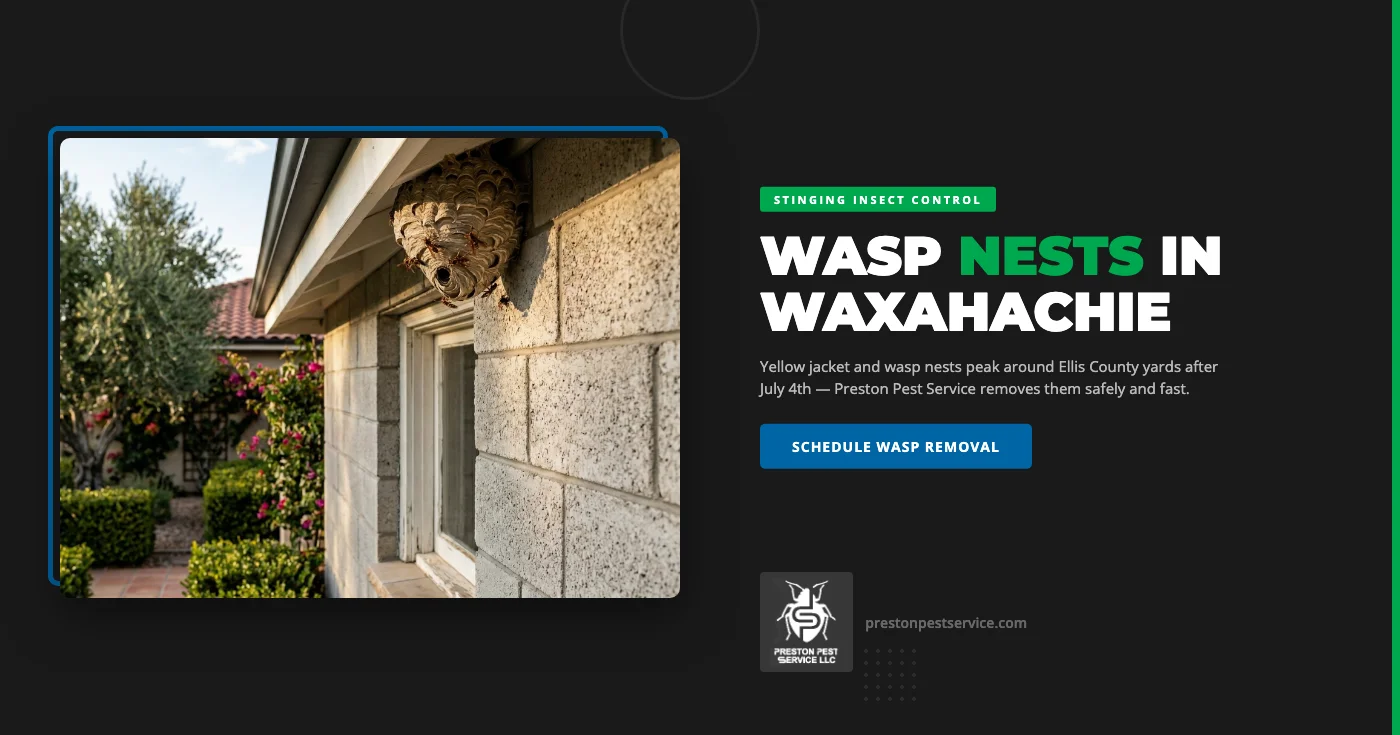
If you've noticed more wasp activity around your Waxahachie home in the past few weeks, you're not imagining it. July marks the height of stinging insect season across Ellis County, and colonies that started building in spring have now grown large enough to pose a real threat to anyone spending time outdoors. Whether it's a yellow jacket nest tucked under your deck or paper wasps hanging from your eaves, wasp control in Waxahachie, TX is something every homeowner needs to take seriously this time of year. Understanding why these insects are so active right now — and what to do about it — can make the difference between a summer spent enjoying your backyard and one spent avoiding it.
Why July Is Peak Season for Wasps and Yellow Jackets in Ellis County
Texas summers are no strangers to heat, but the months of June and July bring a surge in stinging insect activity that catches many homeowners off guard. Wasp and yellow jacket colonies follow a predictable growth cycle that peaks in midsummer, and by July, colonies that began with a single queen in early spring have expanded into populations numbering in the hundreds — or even thousands.
The biology behind this surge is straightforward. Queen wasps emerge from hibernation in the spring and begin constructing small nests, laying eggs and raising the first generation of worker wasps. As workers take over foraging and nest expansion duties, the queen focuses on reproduction. By the time July arrives, colonies across Ellis County are at or near their maximum size, with workers aggressively foraging for food and defending their territory. The hot, dry conditions that define a North Texas summer also push stinging insects to seek water and food sources closer to human activity — patios, garbage cans, outdoor kitchens, and backyard gardens become prime foraging grounds.
Understanding the seasonal timeline matters because it shapes how you should respond. A small paper wasp nest discovered in April is a very different situation from the same nest discovered in July — by midsummer, colony size and aggression levels are both considerably higher.
Post-July 4th Backyard Gatherings: Why Stinging Insects Spike After the Holiday
The days immediately following Independence Day represent one of the riskiest windows of the summer for stinging insect encounters. The combination of warm weather, outdoor entertaining, and an abundance of food and sugary drinks creates ideal conditions for yellow jackets and wasps to intersect with human activity.
Yellow jackets, in particular, are strongly attracted to proteins and sweets — both of which tend to appear in abundance at summer cookouts and gatherings. Grilled meats, open soda cans, fruit, and even the residue left on outdoor surfaces after a party all signal a food source to foraging workers. Once a scout discovers a reliable food supply, it communicates the location to colony mates, and the traffic quickly escalates.
The problem is compounded by the fact that yellow jacket colonies are at or near their peak size in early July, meaning more foragers are actively searching for food. The heightened defensive instincts of a large, mature colony also mean that accidental disturbances — bumping a nest while retrieving something from a shed, or mowing over a ground nest — are far more likely to result in stings. Children and pets exploring the yard are especially vulnerable. For families in Waxahachie and the surrounding Ellis County area, the week after July 4th is the ideal time to inspect your property and address any nesting activity before it creates a dangerous situation.
Common Stinging Insects Found Around Waxahachie Homes and Yards
Not all stinging insects are the same, and knowing which species you're dealing with helps inform the right response. Ellis County is home to several species that commonly nest in and around residential properties.
Paper Wasps are among the most frequently encountered. These slender, long-legged wasps build the open, umbrella-shaped nests you often see hanging from eaves, porch ceilings, window frames, and fence rails. Paper wasp nests are made from chewed wood fiber and have a distinctive honeycomb appearance. While they're not as aggressive as yellow jackets, paper wasps will sting readily if their nest is disturbed or if they feel threatened.
Yellow Jackets are the stinging insect responsible for most sting incidents at outdoor events. Smaller and stockier than paper wasps, yellow jackets are highly aggressive defenders of their colonies. They often nest underground, inside wall voids, or beneath wood piles and debris. Ground nests are particularly hazardous because they're easy to disturb accidentally, and a single disturbance can trigger a rapid, mass response from hundreds of workers.
Bald-Faced Hornets build the large, papery, football-shaped nests you sometimes see suspended in trees or attached to structures. These insects are a type of yellow jacket but are notably larger and more aggressive. Their nests can contain several hundred workers by midsummer, and they will actively pursue perceived threats over considerable distances.
Mud Daubers are solitary wasps that build small, tube-shaped mud nests on walls, under eaves, and inside garages. They are far less aggressive than social species like yellow jackets or paper wasps and rarely sting unprovoked. Their nests, while unsightly, generally don't pose the same level of concern as a social colony.
Cicada Killers deserve a mention because they're frequently mistaken for something more dangerous. These large, solitary wasps dig burrows in loose soil and sandy areas. Despite their intimidating size, they are not aggressive toward people and rarely sting unless physically handled. That said, their digging activity can be disruptive to lawns and garden beds, and their appearance often causes unnecessary alarm.
Correctly identifying the species is an important first step, since different insects nest in different locations and require different treatment approaches. Misidentifying a species can lead homeowners to apply the wrong product in the wrong location — often with poor results and sometimes with the unintended consequence of agitating the colony rather than eliminating it.
Where Wasps Build Nests — and Why You Shouldn't DIY the Removal
Stinging insects are resourceful nesters, and the spots they choose are often difficult to access, easy to miss during a casual inspection, or both. Common nesting locations around residential properties include:
- Eaves, soffits, and overhangs on the exterior of the home
- Attic spaces and wall voids accessed through gaps in siding or fascia
- Underground burrows in lawn areas, garden beds, and embankments
- Inside sheds, garages, and outbuildings
- Beneath decks, porches, and outdoor furniture
- Inside dense shrubs, hedges, and ornamental plantings
- Wood piles, rock piles, and debris accumulated around the yard
The temptation to handle a nest with a can of store-bought aerosol spray is understandable, but DIY removal carries significant risks that are often underestimated. Most over-the-counter wasp sprays are designed to knock down individual wasps, not to fully treat an established colony — and partial treatment can make remaining colony members more defensive and aggressive, not less.
Ground nests present a particular hazard. Without knowing the full extent of the nest and the number of workers present, disturbing the colony even slightly can trigger a rapid defensive response. Yellow jackets nesting in wall voids present another complication: killing the colony without removing the nest material can lead to honeycomb decay inside the wall, attracting other pests and causing structural problems over time.
There's also the matter of personal well-being. For individuals with venom allergies, a single sting can trigger a serious medical response. Even without a known allergy, receiving multiple stings simultaneously — which is common when a large colony is disturbed — can cause significant reactions. Children are especially vulnerable, both because of their smaller body size and because they're often unaware of the need to retreat slowly and calmly when stinging insects are nearby. A panicked run can trigger pursuit, and fast movement signals a threat to a defensive colony.
Timing is another factor that DIY attempts frequently get wrong. Attempting to treat a nest during peak activity hours — typically mid-morning through early afternoon when foragers are most active — dramatically increases the likelihood of contact with workers returning to or departing from the nest. Professional pest control technicians understand the behavioral patterns of stinging insects, have the protective equipment, and have access to professional-grade products that penetrate colony structure in a way consumer sprays cannot. Addressing a nest correctly the first time is far preferable to a failed attempt that leaves an agitated, partially treated colony in place.
How Preston Pest Service Safely Eliminates Stinging Insect Colonies
Preston Pest Service takes a methodical approach to stinging insect elimination that begins with a thorough inspection of the property. Not all nests are immediately visible, and an experienced technician knows where to look — including locations that homeowners typically overlook, such as wall voids, underground cavities, and the interior spaces of outbuildings.
Once nesting sites are identified, treatment is tailored to the species and nest location. Social colonies like yellow jackets and paper wasps require direct colony treatment using professional-grade products that penetrate deep into the nest structure, not just the exterior. For underground nests, this often means treating the nest entrance and surrounding area at a time when colony activity is lower — typically early morning or evening — to maximize effectiveness while reducing the chance of encountering foraging workers.
Above-ground nests on structures are treated and removed whenever access allows. Removing the physical nest material, rather than just treating it, prevents the nest from being recolonized and eliminates the attractant properties of the residual comb material. Technicians also inspect for and treat secondary nest sites that may not have been initially obvious.
For homeowners concerned about ongoing protection through the remainder of the summer, Preston Pest Service can discuss preventive applications and follow-up monitoring. Stinging insect season in North Texas runs through September and into early October, so addressing a nest in July doesn't necessarily mean the issue is resolved for the year — new queens emerging from treated colonies may attempt to establish elsewhere on the property.
Our team is familiar with the specific conditions and pest pressures that Ellis County homeowners face. From properties backing up to wooded creek bottoms to homes with mature landscaping that provides abundant nesting habitat, we understand the local environment and approach each job accordingly. For comprehensive stinging insect control designed for the North Texas climate, Preston Pest Service has the experience and resources to handle it effectively.
Book Wasp Removal for Your Waxahachie or Ellis County Home
If you've spotted a nest on your property — or you're dealing with persistent wasp activity without a visible nest — now is the time to act. Stinging insect colonies will continue to grow through the remainder of the summer, and the larger a colony becomes, the more complex and involved the removal process. Waiting is rarely in your favor.
Preston Pest Service provides professional stinging insect removal throughout Waxahachie and the broader Ellis County area, including Midlothian, Ennis, Maypearl, Venus, Red Oak, and surrounding communities. Our technicians are equipped to handle yellow jacket nests, paper wasp colonies, hornet nests, and other stinging insect infestations — wherever they're located on your property.
Protect your family, your guests, and your pets this summer by letting the professionals handle what can be a genuinely hazardous removal. Contact Preston Pest Service today to schedule an inspection and take back your Waxahachie yard before stinging insect season reaches its peak. The well-being of everyone who spends time on your property is worth the call.


