

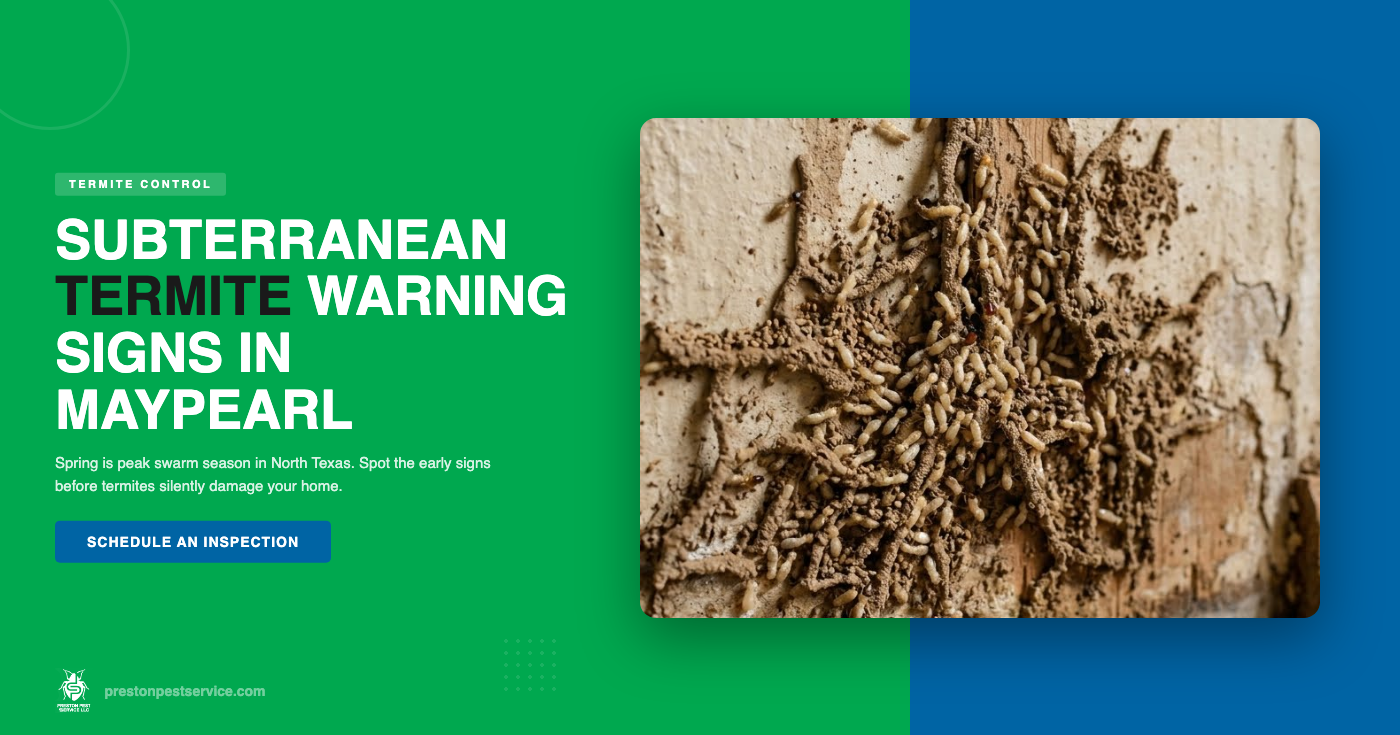
Spring in North Texas brings warm afternoons, sudden rain showers — and the year's biggest wave of termite activity. If you live in Maypearl and you have spotted winged insects swarming around your porch lights or noticed thin mud tubes climbing your foundation, the timing is no coincidence. Searching for termite control Maypearl TX homeowners trust? At Preston Pest Service, we help families across Ellis County catch termite problems before they turn into structural damage that costs thousands to repair.
Subterranean termites are the most destructive wood-eating insect in Texas. Unlike drywood termites, they live in massive underground colonies and tunnel up into homes through hidden routes. A mature colony can contain hundreds of thousands of workers chewing through cellulose around the clock — and most homeowners never see a single termite until damage is already advanced. This guide walks Maypearl homeowners through what spring termite season looks like, the warning signs to watch for, why DIY treatments often backfire, and what our team does to protect your home.
Why Subterranean Termites Thrive in North Texas Spring
North Texas sits inside one of the most active termite zones in the country. The Eastern subterranean termite, Reticulitermes flavipes, is well established throughout Ellis, Johnson, and Hill counties. According to Texas A&M AgriLife Extension, this species is responsible for the vast majority of termite damage to Texas homes.
Spring creates a perfect storm. Soil temperatures climb above 70 degrees, ground moisture stays high from rain, and mature colonies send out reproductive swarmers — winged males and females that fly off to start new colonies. In Maypearl and surrounding Ellis County communities, swarms appear from late February through May, peaking in March and April. Warm, humid mornings after a heavy rain are the most common swarm conditions.
Older homes, properties with mature trees, irrigation systems, and slab foundations close to flowerbeds are especially at risk. Subterranean termites need consistent moisture, and the combination of clay soil, lawn irrigation, and mulch beds gives them everything they need to thrive next to your foundation.
Recognizing the Signs of a Termite Swarm in Maypearl
A swarm is the single most visible sign of a nearby mature colony — and is often the first warning a homeowner ever gets. Watch for:
- Clouds of winged insects emerging from the ground, a foundation crack, or a wood structure on a warm afternoon following rain.
- Small piles of identical wings on windowsills, garage floors, near doorframes, or around exterior light fixtures. Termites shed their wings within minutes of landing.
- Insects of equal size with straight antennae and two pairs of equal-length wings. Flying ants, by contrast, have bent antennae and unequal wings.
- Active emergence from a slab crack, a porch column, a tree stump, or the seam between concrete and siding.
A swarm inside your home — even a few wings on a windowsill — is a strong indicator the colony is nesting under or against your structure. Outdoor swarms in your yard are also worth investigating, because subterranean colonies can extend up to 100 yards from the visible swarm point. Catching termite control Maypearl TX warning signs early gives you a major advantage.
Mud Tubes, Damaged Wood, and Other Indicators
Most subterranean termite activity happens out of sight. Workers tunnel through soil and wood and protect their travel routes with shelter tubes of mud, saliva, and waste. The signs are unmistakable once you know what to look for.
- Mud tubes on the foundation. Pencil-width tubes of dried mud running up a slab, pier, or basement wall are the textbook indicator. They carry workers from the soil up into the wood of your home while shielding them from sunlight and dry air.
- Hollow-sounding wood. Tap door frames, baseboards, and floor joists with a screwdriver handle. Wood that sounds papery or hollow has likely been eaten from the inside.
- Blistered or rippled paint. Termite damage under a painted surface often shows up as blistering or sagging on trim, baseboards, or window frames.
- Doors and windows that suddenly stick. As termites consume framing, jambs warp slightly. A door that worked fine all winter and suddenly will not close cleanly is worth investigating.
- Frass piles or fine dirt in places that should not have any — at the base of an interior wall, inside a closet, or in the corner of a garage.
If you find any of these indicators, do not break open the wood or scrape away the mud tubes — that tips off the colony and pushes workers deeper into the structure.
How Subterranean Termites Damage Maypearl Homes
Termite damage is slow, hidden, and expensive. The US Environmental Protection Agency identifies subterranean termites as the most destructive termite species in the United States, and the US Forest Service estimates termites cause roughly $5 billion in damage and control costs nationwide each year. Most homeowners insurance policies do not cover termite damage, because it is considered preventable through routine maintenance.
In Maypearl and the surrounding North Texas area, the damage we typically see includes:
- Compromised floor joists and subfloors from colonies that tunnel up through plumbing penetrations or slab expansion joints.
- Hollowed-out door frames, baseboards, and window casings in older homes with wood trim near the ground.
- Damaged sheathing and wall studs behind kitchen and bathroom walls, where plumbing moisture creates ideal feeding conditions.
- Weakened porch posts and deck framing, especially on porches sealed off underneath and rarely inspected.
The longer a colony goes undetected, the more expensive the repair gets. A small, recently active infestation might involve a handful of board feet of damaged framing. A colony working for two or three years can require structural reinforcement and trim repairs running well into five figures.
Why Spring Is the Most Important Inspection Window
Spring is the most valuable time of year to schedule a termite inspection in North Texas, and not just because of the swarms. Soil moisture is high, so active mud tubes are visible and recently abandoned tubes are still intact. Swarmers leave wings behind on windowsills and porches, giving our technicians a fast read on which entry points are most active. Wood damage from the previous summer and fall has had a full season to develop, so subtle indicators — sagging trim, blistered paint, sticking doors — become easier to identify.
Catching activity in spring also means treatment happens before the summer growth surge. A colony in March is still recovering from winter slowdown; the same colony in July is operating at full strength with thousands of additional workers. Treating early shortens the timeline to a clear home and lowers the chance that hidden satellite tunnels remain active.
Our team performs detailed termite control Maypearl TX inspections that cover the full perimeter of the slab, every plumbing penetration, attic access points, the garage, and any wood-to-soil contact around porches, decks, and outbuildings.
DIY Termite Treatments That Often Make Things Worse
Hardware stores carry plenty of termite products — foam sprays, granular treatments, soil drenches, and bait stakes. Many homeowners try them first when they spot a mud tube or a few wings. Unfortunately, DIY termite treatment fails far more often than it works, and a failed treatment usually costs more in the long run than calling a professional from the start. Here is why:
- You only treat what you can see. Colonies extend dozens of yards underground with multiple satellite feeding sites. Treating one mud tube simply reroutes the workers.
- Consumer products lack residual strength. Professional termiticides create a continuous protective treated zone that lasts five to ten years. Hardware-store sprays break down within weeks.
- Bait stations require correct placement. Professional bait systems are placed based on foraging patterns, soil conditions, and structural risk points, and inspected on a strict schedule. Stakes from a kit rarely intercept the colony.
- Disturbing the colony triggers retreat. Subterraneans abandon treated tunnels and rebuild routes elsewhere — partial DIY work often makes a full professional treatment more difficult.
- You miss the diagnosis. What looks like termite damage can be carpenter ants, wood-decay fungus, or plain moisture damage. A professional inspection identifies the actual cause first.
If you have already tried a DIY product and the activity is back, tell our technicians what was used and where — that information shapes how we approach treatment.
How Preston Pest Service Protects Maypearl Homeowners
When you contact Preston Pest Service for termite control Maypearl TX homeowners can rely on, here is what the process looks like.
We start with a full property inspection. Our technicians walk the foundation perimeter, check plumbing and utility penetrations, inspect the garage and attached structures, and document every active or historical sign of termite activity. We identify the species, estimate colony location, and explain in plain language what we found before recommending a treatment plan.
For active infestations, we use professional liquid termiticide applications that create a continuous treated zone around the structure — the product binds to the soil and remains effective for years, so foraging termites carry the active ingredient back to the colony. For homes with heavy pressure or recurring activity, we install in-ground bait stations that intercept foragers before they reach the structure.
After treatment, we walk through prevention recommendations specific to your property — moisture management, mulch and irrigation adjustments, wood-to-soil contact corrections, and inspection schedules going forward. Our recurring residential pest control plans include annual termite inspections so new activity is caught early.
We serve Maypearl, Venus, Midlothian, Alvarado, Grandview, Joshua, Italy, Waxahachie, Glenn Heights, Ovilla, and surrounding Ellis and Johnson County communities. Our team has earned a 5.0-star rating across more than 200 reviews from homeowners across the area.
Frequently Asked Questions About Termites in Maypearl
How do I tell termite swarmers apart from flying ants in Maypearl, TX?
Look at three things: wings, antennae, and waist. Termite swarmers have two pairs of equal-length wings, straight bead-like antennae, and a thick uniform waist. Flying ants have unequal wings, bent antennae, and a clearly pinched waist. A pile of identical translucent wings on a windowsill is almost certainly a termite swarm. When in doubt, place a wing on a piece of tape and bring it to our technicians for identification.
When do termites swarm in North Texas?
Eastern subterranean termites — the most common species in Ellis County — typically swarm from late February through May, with the heaviest activity during March and April. Swarms most often happen on warm, humid mornings following a rain. A second smaller swarm window can appear in the fall for some colonies, but spring is by far the most active period in the Maypearl area.
Is termite damage covered by homeowners insurance?
In almost all cases, no. Standard homeowners policies treat termite damage as a maintenance issue, not a sudden covered event, so repair costs come out of pocket. That is why prevention and early detection matter so much — a routine inspection is a fraction of the cost of even minor structural repairs.
How often should a Maypearl home be inspected for termites?
We recommend a professional termite inspection at least once a year, with spring being the ideal window. Homes with prior termite history, heavy landscaping, or wood trim near the ground benefit from twice-yearly inspections. Our recurring service plans include this monitoring on schedule.
Protect Your Maypearl Home Before Spring Swarm Season Peaks
Subterranean termites work quietly, slowly, and from places you cannot see — a small problem this spring can become a major repair bill by the time it is visible. Spotting a swarm, finding a mud tube, or noticing wood that suddenly sounds hollow is the moment to act.
For proven termite control Maypearl TX homeowners trust, contact the team that has earned 5.0 stars across more than 200 local reviews. Preston Pest Service brings the experience, equipment, and local knowledge to handle any termite situation — from a single mud tube to a full-perimeter treatment. Contact us today to schedule your inspection and stay ahead of the season.


