

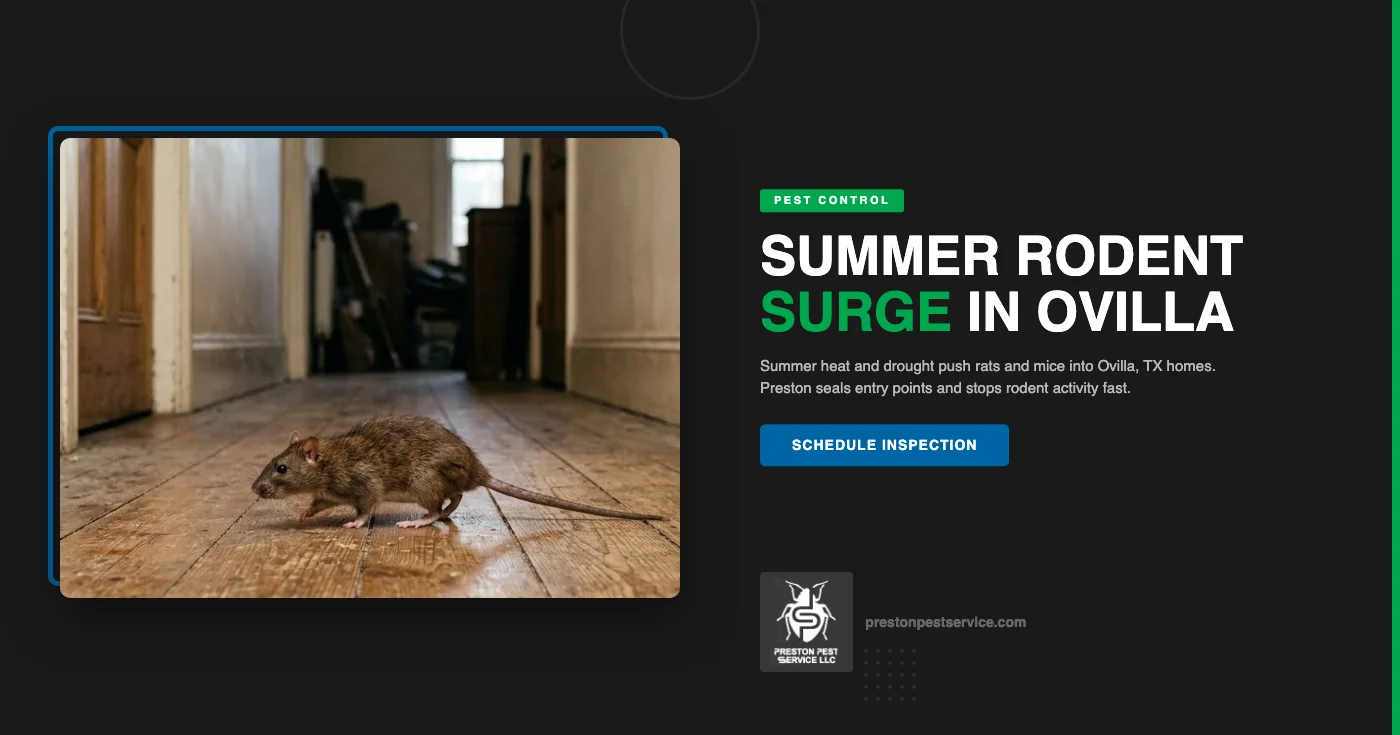
If you've noticed fresh droppings on a garage shelf, heard scratching in the ceiling at 2 a.m., or spotted a rat crossing a fence line at dusk, you're not alone. July in Ovilla, TX is one of the busiest months of the year for rodent activity, and this summer's stretch of triple-digit heat and stubborn drought has driven rats and mice into homes across Ellis County. When outdoor temperatures push past 100°F and creeks, ponds, and ornamental gardens dry out, rodents move toward the closest source of water, cool air, and shelter — usually a residential attic, garage, or wall void. If you're looking for reliable rodent control in Ovilla TX this July, understanding what's driving the activity is the first step toward keeping your home protected.
Why July Heat and Drought Push Rodents Into Ovilla Homes
North Texas summers push local wildlife into survival mode, and rodents are no exception. Both rats and mice need daily access to water — a house mouse survives on just a few drops, but it has to find them every day. When natural water sources dry up during a drought, the drip from an air-conditioning condensate line, moisture beneath a leaking hose bib, or a pet's water bowl on the back patio becomes an irresistible attractant.
Heat is the second driver. Rodents avoid direct sun and prefer stable temperatures between the mid-70s and low 80s. As afternoon highs across Ovilla push into triple digits, outdoor burrows in pastures and fence lines become hostile. The air-conditioned interior of a home — especially the shaded space under an insulated roof deck or between wall studs — offers exactly the microclimate a rat or mouse is looking for.
We see this pattern every July. Calls for rodent control in Ovilla and surrounding communities climb sharply once the first extended heat wave settles in, and they don't taper off until autumn.
Roof Rats vs. House Mice: What Ellis County Homeowners Face in Summer
Two rodent species account for the vast majority of infestations we handle around Ovilla: the roof rat and the house mouse. Knowing which you're dealing with matters — their entry patterns and hiding spots differ.
Roof rats (Rattus rattus) are the most common rat species across Texas, according to Texas A&M AgriLife Extension. Sleek and dark brown to black, an adult roof rat measures 6 to 8 inches from nose to base of tail, with a tail that adds another 7 to 10 inches. True to their name, they prefer high places — attics, rafters, upper cabinets, and the space between the roof deck and insulation. Roof rats are excellent climbers and travel along fence lines, utility wires, and overhanging tree branches to reach a home's roofline.
House mice are much smaller, typically 3 to 4 inches long with large ears and a pointed snout. Unlike roof rats, they're just as likely to enter at ground level. Once inside, they nest in wall voids, behind appliances, inside stored boxes in the garage, and beneath attic insulation. A single female mouse can produce five to ten litters per year, so a small early-summer sighting can turn into a widespread problem by fall.
Both species are active mostly after dark during a Texas summer, which is why homeowners often notice noises overhead in the middle of the night before they ever see the animal responsible.
Where Rodents Get In: Common Entry Points on Ovilla TX Homes
Rats and mice can compress their bodies through gaps that look far too small. A house mouse squeezes through an opening the size of a dime, and a rat can fit through a nickel-sized hole. Texas A&M AgriLife Extension recommends sealing every opening larger than one-quarter inch to genuinely rat-proof a building.
When we inspect an Ovilla home for rodent entry points, we check the same weak spots on every property:
- Roof and soffit intersections — where the roofline meets the exterior wall, a small gap in the soffit or a lifted piece of drip edge is a favorite roof-rat entry.
- Gable and turbine vents — torn or unsecured screens let rats step right into the insulation.
- Plumbing and utility penetrations — the holes where water lines, gas lines, and electrical conduit enter the wall are almost always oversized.
- Garage door bottom seals — worn, cracked, or missing seals leave a ground-level gap across the entire door width.
- Foundation weep holes and expansion cracks — house mice frequently use these to move from the yard into the wall cavity.
- Dryer and range hood vents — flapper doors that no longer close tightly let rodents follow the exhaust duct straight into the home.
- Uncapped chimneys — an open flue is an open invitation, especially for roof rats.
Landscaping matters too. Tree branches within four feet of the roof, dense ivy on an exterior wall, or wood piles stacked against the foundation give roof rats an easy on-ramp. Trimming vegetation back is one of the least expensive prevention steps a homeowner can take.
Warning Signs of a Summer Rodent Infestation in Your Attic or Garage
Rodents are careful, so the earliest signs of activity are usually indirect. If you notice any of the following around your Ovilla home this summer, take a closer look:
- Droppings. Mouse droppings are small — roughly the size of a rice grain, dark, and pointed at both ends. Rat droppings are larger, capsule-shaped, and up to three-quarters of an inch long. Fresh droppings look shiny and moist; older ones are dull and crumbly.
- Gnaw marks. Rodents chew constantly to keep their incisors trimmed. Look for shredded cardboard, chewed weather stripping, gnawed corners on wooden studs, and shavings along baseboards.
- Grease trails. Rats and mice leave dark, oily smudges along the walls, floorboards, and rafters they travel repeatedly — the residue comes from oils in their fur.
- Nesting material. Shredded insulation, chewed paper, fabric scraps, or dried grass gathered into a loose bundle in a corner of the attic or garage almost always indicates active nesting.
- Nighttime scratching or scurrying. Sounds in the ceiling, walls, or attic between midnight and dawn are one of the most common calls we receive during July.
- Distressed pets. Dogs and cats often notice rodents in walls or attics long before their owners do — persistent attention to a specific spot is worth investigating.
Even one or two of these signs is enough to justify a professional inspection. A single visible mouse usually means a small population is already established out of sight.
Health and Property Risks of Ignoring Rodent Activity
Rodents are more than a nuisance. Both rats and mice carry pathogens that can affect people and pets, and they cause structural damage that costs Ellis County homeowners thousands of dollars every year.
The Centers for Disease Control and Prevention lists hantavirus as one of the most serious rodent-borne illnesses in the United States. Hantavirus spreads when contaminated urine, droppings, or nesting material become airborne — often during ordinary cleaning activities like sweeping or vacuuming. The CDC specifically warns homeowners not to sweep or vacuum droppings in an enclosed space, because the dust that gets stirred up can be inhaled and can cause serious lung and kidney illness. Salmonella, leptospirosis, and rat-bite fever are additional concerns tied to active rodent populations.
Property damage is usually the risk homeowners notice first. Rodents chew electrical wiring in attics, and gnawed wire insulation is a recognized cause of house fires. They also pull apart fiberglass and cellulose insulation to build nests, degrading the R-value of your attic and driving up cooling costs during exactly the months you need efficient insulation most. Roof rats and house mice will chew into drywall, air-conditioning ducts, PVC plumbing lines, and stored belongings in the garage. What starts as a small opening in the soffit can become a repair invoice several times the size of a professional rodent-control service.
Left alone, a summer rodent population doesn't stay small. By late fall, a family of six mice can grow into dozens, and by spring, the same home may be dealing with a widespread infestation across attic, wall voids, and crawl spaces.
How Preston Pest Service Removes Rodents and Seals Your Home
Our approach to Rodent Control in Ovilla and across Ellis County follows a structured inspect–remove–seal–monitor process. Every home is different, but the core steps are consistent.
Inspection. We begin with a thorough walk of the property — attic, garage, foundation, roofline, and interior spaces where you've noticed activity. We document the rodent species involved, map active runways and entry points, and identify the environmental factors that are pulling animals to the home in the first place.
Removal. Depending on the level of activity and the species involved, we deploy a combination of snap traps, tamper-resistant bait stations, and multi-catch devices. Every treatment is chosen to match the layout of the home and to work around children and pets.
Exclusion. Removal without exclusion is a short-term fix. We seal the gaps, vents, and utility penetrations that let rodents in, using materials that stand up to gnawing — hardware cloth, copper mesh, and quality sealants rather than expanding foam alone. This is the step that turns a one-time cleanup into a lasting result.
Monitoring and follow-up. We return to reinspect, replenish bait as needed, and verify that activity has stopped. If new signs appear later in the season, we come back and adjust the program.
Preston Pest Service is headquartered right here in Ellis County, so we know how North Texas heat, drought, and construction patterns shape rodent pressure on Ovilla homes.
Book Rodent Control for Your Ovilla or Ellis County Home
Summer rodent activity in Ovilla, TX is not going to slow down until the first cool fronts arrive in October. Between now and then, every week of unresolved activity means more droppings in the attic, more gnawed wiring, and more reproduction. A small problem discovered in July is far less expensive to correct than a full-attic infestation discovered in November.
Preston Pest Service provides professional rodent control across Ovilla and the surrounding Ellis County communities — Venus, Midlothian, Maypearl, Glenn Heights, Alvarado, Grandview, and Joshua. Whether you've heard something in the attic, spotted droppings on the garage floor, or you're not sure what you're dealing with, we can inspect the property, identify the species involved, and put together a plan tailored to your home.
Reach out today to schedule your rodent inspection and take back your attic, garage, and peace of mind before the next heat wave settles in.
Frequently Asked Questions About Summer Rodent Control in Ovilla
Why are rats coming into my Ovilla TX home in July?
July's combination of prolonged 100°F heat and drought-driven water shortages pushes rats out of their outdoor burrows and toward the closest reliable water and shelter — usually a residential home. Air-conditioned attics, garages with dripping condensate lines, and pet water dishes on back patios all become powerful attractants.
How do I get rid of mice in my attic during a Texas heat wave?
Trapping alone rarely resolves an attic mouse problem, because more mice keep entering through the original gaps. The real solution is to inspect for entry points, remove the current population with a combination of snap traps and bait stations, seal every opening larger than a quarter inch, and follow up to confirm the activity has stopped.
What are the signs of roof rats in North Texas homes during drought?
Roof rats leave dark, capsule-shaped droppings — often along attic beams or in the corners of upper cabinets — and produce distinctive nighttime scurrying overhead. Grease smudges on rafters, gnawed insulation, and a musky odor from concentrated urine are also common signs of an established roof rat population.
Who is the best rodent exterminator near Ovilla and Ellis County TX?
Preston Pest Service serves Ovilla, Venus, Midlothian, Glenn Heights, and the rest of Ellis County with rodent inspection, removal, exclusion, and follow-up monitoring. Our team lives locally and builds a program around the specifics of your home.


