

If you live in Grandview, TX and you've noticed more eight-legged visitors in your laundry room, garage, or porch light over the past few weeks, you're not imagining it. Summer is peak spider season across Johnson County, and the spike isn't random. Heat, food, and breeding behavior overlap in a way that pushes spiders closer to where people actually live. At Preston Pest Service, we've spent years on spider control grandview tx calls every June and July, and we want to share what's really happening — and what we recommend doing about it. This guide covers which species show up in local homes, when to be concerned about venomous spiders, and why professional treatment outperforms anything on the hardware store shelf.
The Three Conditions That Trigger Summer Spider Activity in Grandview, TX
Three overlapping conditions drive the seasonal jump in sightings:
- Texas heat pushes prey indoors. When daytime highs climb past 95°F, smaller insects — gnats, mosquitoes, beetles, moths, crickets — look for cooler, shaded spots. Air-conditioned homes, shaded garages, and damp crawl spaces become magnets. Spiders are predators, so wherever insect populations concentrate, spiders follow.
- Humidity creates ideal hunting conditions. Spiders draw moisture from the air and from the bodies of their prey. Bathrooms, laundry rooms, basements, and any room with poor ventilation tend to be the first interior hotspots.
- Mating and egg-laying peak in June and July. Many North Texas spider species reach maturity in early summer. Males wander in search of females, which is why so many of the larger, more visible spiders people encounter at this time of year are males on the move. Females, meanwhile, settle into quiet corners to lay egg sacs that hatch later in the summer or fall — meaning today's egg sac is next month's population problem.
When all three converge in Grandview's typical July weather, sighting frequency easily doubles or triples compared with spring. That's not a sign your home has suddenly become a problem — it's a sign the season has arrived.
Common House Spiders Found in Johnson County Homes
Most of the spiders our crews encounter inside Grandview homes are harmless and even helpful — they prey on other pests. Knowing what you're looking at takes the guesswork out of every sighting:
- Common house spider (Parasteatoda tepidariorum). Small, tan or brown, builds tangled cobwebs in upper corners, basements, and storage rooms. The dusty cobweb in the ceiling corner is almost always this species.
- Cellar spiders ("daddy long-legs"). Long, fragile legs and a small body. Hangs upside down in webs in garages, sheds, and bathroom corners. Not dangerous despite the urban myth.
- Wolf spiders. Large, fast, and ground-hunting. They don't build webs and are often seen sprinting across a garage floor. Their size startles people more than their bite, which is rarely a medical concern.
- Grass spiders. Build funnel-shaped webs in lawns, ground cover, and along foundations. Most often spotted in the morning when dew highlights the web.
- Jumping spiders. Small, compact, and surprisingly visual. They stalk prey on window sills, porches, and exterior siding. Curious and quick, but harmless to people.
The vast majority of spiders inside Grandview homes belong to this group. Knowing the everyday species also makes it easier to spot the two we do want every Johnson County family to recognize on sight.
Dangerous Spiders to Know: Black Widow and Brown Recluse Signs
Texas has two medically significant venomous spiders, and both live and breed in Johnson County. According to the Texas Department of State Health Services, they're well established across the state, and we run into them regularly during summer inspections around Grandview, Venus, Alvarado, and the surrounding communities.
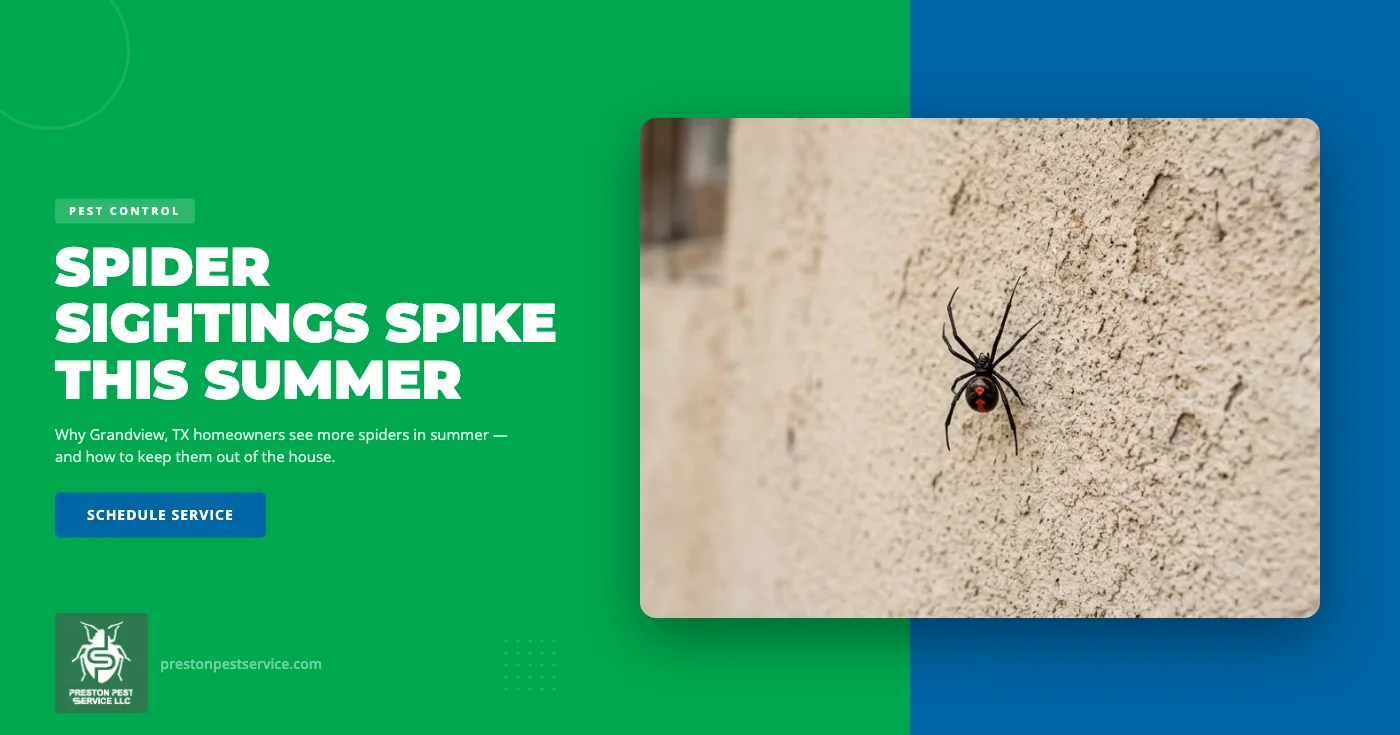
Black widow (Latrodectus mactans).
- Females are jet-black with a globular abdomen and a red or yellow hourglass mark on the underside.
- Common hideouts: woodpiles, meter boxes, shed corners, under outdoor furniture, inside seldom-used patio storage, outdoor toilets, and barns.
- Bites can cause cramping, sweating, nausea, and severe abdominal pain within an hour. Texas Poison Center Network is reachable 24/7 — keep their contact info handy if you have small children or pets.
Brown recluse (Loxosceles reclusa).
- Light golden-brown body with a darker violin-shaped pattern just behind the eyes.
- Prefers undisturbed dark spaces — garage storage boxes, attic insulation, stacks of folded clothes, behind baseboards, under untouched furniture.
- Bites are often painless at first but can develop into tissue damage at the bite site. Seek medical attention promptly if you notice an expanding lesion.
The single best habit during summer in Grandview is the one Texas Parks & Wildlife recommends in their arachnid guidance: shake out shoes, gloves, and stored clothing before putting them on — especially anything pulled from a garage, shed, or attic.
What Outdoor Lighting and Landscaping Have to Do With It
A lot of the summer spider problems we treat in Grandview start outside, not inside. Two factors stand out:
Exterior lighting attracts insects, which attracts spiders. Porch lights, garage floodlights, and uncovered window lights pull in moths, gnats, and beetles all night long. Spiders quickly figure out that these light pools are reliable feeding spots. Within a few weeks of summer, you'll see webs strung between siding, eaves, and light fixtures. Switching to yellow "bug" bulbs, motion-activated fixtures, or warmer color temperatures dramatically reduces insect traffic — which in turn reduces spider activity within feet of your doors and windows.
Landscaping right against the foundation becomes a highway. Thick mulch beds, overgrown shrubs touching siding, ivy climbing walls, wood piles stacked against the house, and stones or pavers butted up to the foundation all provide cool, humid, undisturbed hiding spots for spiders. We routinely find black widows in firewood stacks and grass spiders in untrimmed mulch beds during summer inspections. A six-inch gap of bare ground between mulch and siding — what our team calls a "gravel break" — makes the boundary far less hospitable.
When we treat a Grandview property for spiders, the perimeter — lighting, vegetation, ground contact — is where the work starts.
How to Tell a One-Off Sighting From an Active Infestation
A single spider crawling across the den floor in July is almost certainly nothing to act on. What our technicians look for, and what homeowners should watch for, is a pattern:
- Multiple spiders in the same room within a week, especially in basements, garages, laundry rooms, or pantries.
- Egg sacs. Small, papery or silky balls roughly the size of a pea, often tucked into corners, behind furniture, or in window tracks. A single sac can contain dozens to hundreds of eggs.
- Visible webbing in places it wasn't before. Cobwebs returning days after you remove them, funnel webs along the foundation, or sticky strands across doorways at night.
- Sightings of the same species in different rooms. This usually means a breeding population is present, not a single wanderer.
- Shed exoskeletons. Spiders molt as they grow. Finding small translucent "skins" near baseboards or windowsills indicates active residents.
Any one of these on its own is mild. Two or more together — especially when the species is a black widow or brown recluse — is the threshold at which we recommend a professional inspection rather than another DIY attempt.
Why DIY Spider Sprays Rarely Work in Texas Heat
This is the question we hear most often from new clients in Grandview: "I sprayed three times — why are they back?" The honest answer involves spider biology and Texas summer chemistry:
- Spiders don't groom themselves the way ants and roaches do. Most retail residual sprays rely on the pest walking through a treated surface and then ingesting product while cleaning itself. Spiders mostly walk on the very tips of their legs and don't groom in the same fashion, so they pick up far less of the active ingredient.
- UV and heat break residuals down fast. A residual labeled for 60–90 days can lose most of its effectiveness in two to three weeks of direct Texas sun. Apply it to a south-facing porch in July and you may have a handful of days of protection at best.
- Most aerosols are contact-kill only. They handle the spider in front of you but do nothing about egg sacs, hidden adults, or the next wave that walks in tomorrow.
- The perimeter and harborage are usually untouched. Spraying baseboards inside the home doesn't address the mulch beds, woodpile, and porch lights that are producing new spiders every week.
Hardware-store spider sprays can knock down the spider you can see. They rarely change the population over the course of a North Texas summer — which is why most homeowners who try DIY twice end up calling us for professional spider control grandview tx residents can actually count on.
When Grandview Homeowners Should Call a Spider Control Pro
There's no harm in coexisting with a few harmless house spiders. We tell families that all the time. The situations where it makes sense to bring our team in are more specific:
- You've identified a black widow or brown recluse anywhere on the property, especially where children or pets spend time.
- Sightings have moved past one-offs into a recurring pattern across multiple rooms.
- You've found egg sacs and want them removed before they hatch.
- You're preparing a garage, shed, or attic for use and want the space cleared and treated first.
- A new baby, an elderly parent, or anyone with allergies or compromised immunity has joined the household, and the peace of mind of a professionally treated home matters more than it did a year ago.
When we run spider control in a Grandview home, the visit includes a perimeter inspection, identification of any high-risk species and harborage points, removal of webs and accessible egg sacs, targeted treatment of entry points and harborage zones, and a written set of property recommendations — lighting, landscaping, storage — tailored to that specific home. For homeowners who would rather not deal with the seasonal cycle at all, the same coverage is built into our residential pest control plans, which protect against spiders alongside ants, roaches, scorpions, and the other summer pests we treat every week across Johnson County.
Frequently Asked Questions
When does spider season start and end in Grandview, TX?
Activity ramps up in mid-to-late May, peaks from June through August, and tapers off in October as overnight temperatures drop. Because females lay eggs in summer, a second visible bump can show up in early fall as those eggs hatch.
Are black widows really common in Johnson County?
Yes. Texas DSHS lists them as established statewide, and we encounter them most often in woodpiles, meter boxes, shed corners, and untouched outdoor storage during summer treatments around Grandview, Venus, Alvarado, and Cleburne.
Will one treatment fix the problem for the whole summer?
Most homes do well with a single thorough summer service combined with perimeter changes. Heavier infestations, or properties with significant wooded backing, often benefit from quarterly visits.
Do you use products that are gentle around pets and children?
Yes — the products we apply are professional-grade and chosen for use in occupied homes. Our technicians walk every family through application zones, dry times, and any short-term access recommendations before they leave the property.
What should I do if I think I've been bitten?
For any suspected black widow or brown recluse bite, seek medical attention and contact the Texas Poison Center Network for treatment guidance. If you can do it without further risk, take a photo of the spider — accurate identification helps medical staff choose the right treatment.
Summer Spider Control in Grandview, TX Starts at the Perimeter
Summer in Grandview brings out the spiders every year. With the right combination of perimeter changes and professional treatment, the same home seeing weekly sightings in July can be quiet again by August. Our team has been doing this work across Johnson County for years, and we're glad to walk any homeowner through the options — whether that's a one-time spider-focused visit or a quarterly residential plan that keeps the whole pest picture under control year-round.


