

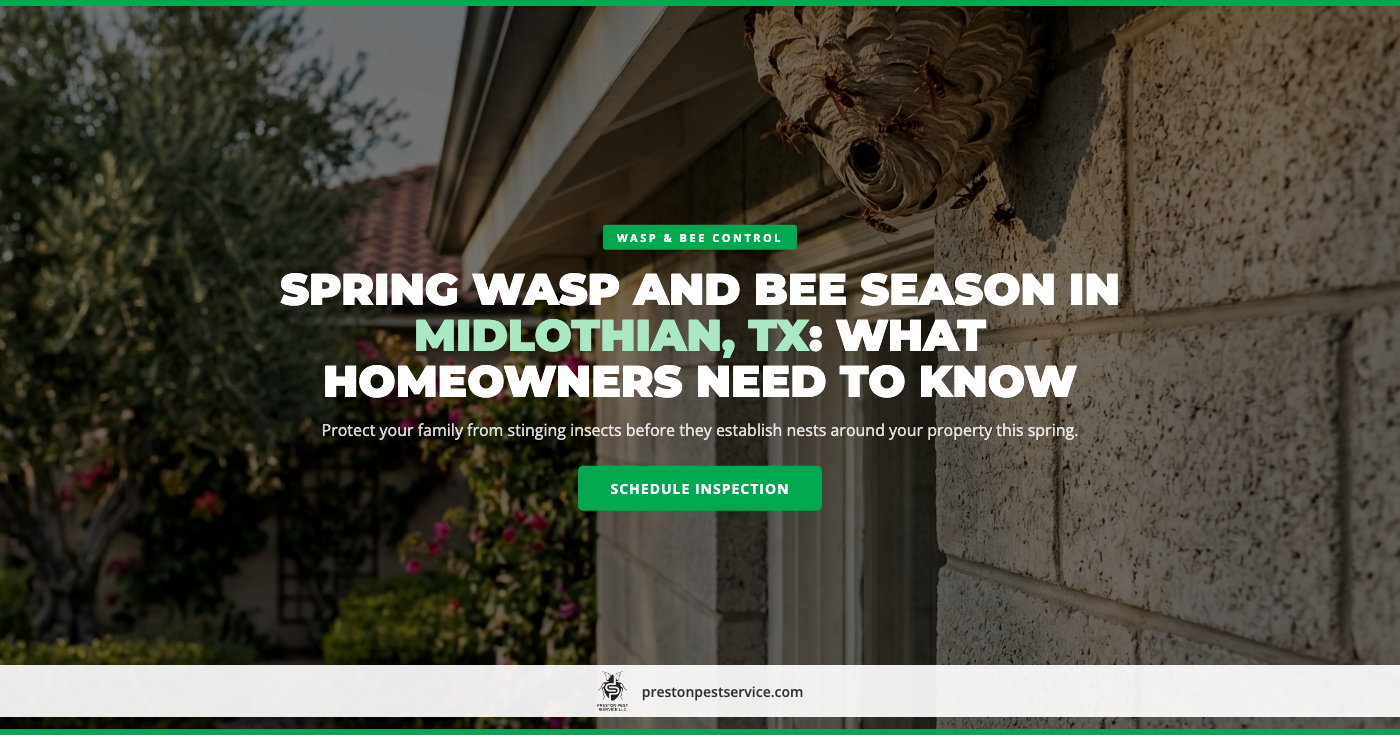
Spring is here, and stinging insects are on the move. If you have spotted wasps flying near your eaves or bees clustering around a gap in your siding, it is time to act. Searching for wasp and bee control Midlothian TX residents trust? At Preston Pest Service, we help families across Midlothian address stinging insect problems before they grow into something far harder to manage.
Texas springs move fast. A nest that appears in early April can triple in size by May. Warm winters across Ellis County mean more queen wasps and bees survive to start new colonies each year. Recognizing the signs early and acting quickly gives you the best chance of resolving the issue with minimal disruption to your household.
This guide covers what Midlothian homeowners need to know this season — from identifying the most common local species to understanding why professional removal is the right call, and what our team does to get your property clear and keep it that way.
Why Spring Is Peak Season for Wasps and Bees in Midlothian, TX
As temperatures climb above 60 degrees Fahrenheit, queen wasps and bees that overwintered in protected spots begin building new nests. In the early weeks of spring, a queen works alone. Once her first generation of workers hatches — often by late March or early April — nest-building accelerates dramatically. According to Texas A&M AgriLife Extension, paper wasp colonies can grow from a handful of workers to several hundred within a single warm season.
The climate in the Midlothian area plays a direct role in this surge. Mild winters mean more queens survive compared to colder regions. Warm, dry spring conditions push wasps and bees closer to homes in search of water and food — outdoor kitchens, pet bowls, uncovered garbage cans, and garden drips all become magnets for foraging insects.
Spring colonies are smaller and queens are still establishing territory. That makes this the best window for removal. By late summer, a colony is fully established, far more defensive, and considerably harder to treat. Our team at Preston Pest Service sees a consistent surge in stinging insect removal calls starting in late March — getting ahead of that curve means faster scheduling and better outcomes.
Common Stinging Insects Found in the Midlothian Area
Not every stinging insect is the same, and identifying the species matters when it comes to removal approach and urgency.
Paper Wasps build small, open-comb nests shaped like upside-down umbrellas on eaves, window frames, and porch ceilings. They are not aggressive unless disturbed, but their venom can cause serious reactions in sensitive individuals.
Yellow Jackets often nest underground or inside wall cavities. They are highly defensive, sting multiple times, and are attracted to sugary foods — making outdoor gatherings risky when a colony is nearby.
Bald-Faced Hornets build large papery gray nests on tree branches, soffits, or utility structures. These colonies can hold several hundred workers and are highly aggressive — they can spray venom at the eyes of perceived threats without proper protective equipment nearby.
Honey Bees swarm in spring as established colonies split. Swarms on fence posts or tree limbs are often temporary, but bees that move into a wall void or attic space can establish a permanent hive. Because honey bees are valuable pollinators, our approach focuses on relocation where possible.
Carpenter Bees drill into untreated or weathered wood — fascia boards, deck rails, and fencing — to build nesting tunnels. Over time their damage can compromise structural wood and attract woodpeckers.
Warning Signs of a Wasp or Bee Nest on Your Property
Catching a nest early makes removal faster and less disruptive. Watch for these signs around your Midlothian home as spring gets underway:
- Repeated insect traffic near one spot. Wasps or bees flying repeatedly to and from the same location — a soffit vent, a gap in the siding, a spot under the deck — is a strong indicator of an active nest.
- Visible nest structures. Paper wasp nests, hornet nests, and exposed comb are often visible on eaves, porch ceilings, and outdoor furniture if you look carefully.
- Buzzing sounds inside walls or ceilings. A persistent buzzing from within a wall during daylight hours can mean a bee or yellow jacket colony has nested inside the structure.
- Round holes in wood surfaces. Perfectly round, dime-sized holes in wooden surfaces are the signature of carpenter bees. Fresh sawdust beneath the holes indicates active nesting.
- Aggressive behavior near a specific area. If you or your pets are being followed or pursued when approaching part of the yard, there is likely an active nest in that zone.
If you spot any of these warning signs, avoid disturbing the area. Contact a professional before attempting to investigate — disturbing a live colony without protection can trigger an immediate defensive response.
DIY vs. Professional Removal: Why the Risks Aren't Worth It
Consumer wasp sprays and online removal guides make DIY treatment look straightforward. In reality, most stinging insect situations Midlothian homeowners encounter are far more complex than a can of aerosol spray can handle.
Here is what typically goes wrong:
- Incomplete treatment. Consumer sprays kill on contact but rarely penetrate deep enough to eliminate the queen or the full colony. Surviving workers rebuild within a week or two.
- Hidden nests. Yellow jacket and honey bee nests inside wall voids or underground cannot be treated from the outside. Forcing spray into a wall cavity can drive insects deeper into the structure — or into your living space.
- Protective gear gaps. Professional technicians use full suits, sealed gloves, and respirators. Even one gap in improvised home protection can mean multiple stings. Bald-faced hornets and yellow jackets target the face.
- Allergic reaction risk. According to the American College of Allergy, Asthma, and Immunology, roughly three percent of people have a severe allergic response to insect venom. Many do not know their sensitivity until they are stung.
- Structural damage from untreated hives. Sealing off a honey bee nest without removing the comb and honey leads to decay that can attract rodents, promote mold growth, and damage framing and insulation over time.
Professional removal is not just more effective — it protects your household from the unpredictable outcomes that come with disturbing a live colony without the right tools and training.
Professional Stinging Insect Elimination by Preston Pest Service
When you contact Preston Pest Service for wasp and bee control Midlothian TX property owners can rely on, here is what to expect.
We start with a thorough inspection. Our technicians check eaves, soffits, utility penetrations, fence lines, outbuildings, and ground-level areas for active nests and entry points. We identify the species, assess colony size, and determine whether the nest is accessible from the exterior or located inside a structural void.
Treatment is tailored to the species and location. Exposed paper wasp and hornet nests receive targeted treatments that eliminate the colony. Yellow jackets nesting underground or in wall cavities are treated with dust or foam-based products that penetrate the full colony. For honey bee situations, we assess whether live removal and relocation is appropriate.
After treatment, we physically remove accessible nests. Leaving a dead nest can attract new queens the following season, so removal is part of our standard process. We also discuss sealing recommendations for entry points found during the inspection.
We serve Midlothian, Venus, Maypearl, Alvarado, Grandview, Joshua, Glenn Heights, Ovilla, and surrounding communities. Our team has earned a 5.0-star rating across more than 200 reviews from homeowners throughout Ellis and Johnson counties.
Preventing Future Nest Activity Around Your Home
After treatment, a few consistent habits go a long way toward keeping stinging insects from returning to your property.
- Seal exterior gaps early. Walk your home's perimeter in late February and seal gaps in siding, soffits, fascia boards, and utility penetrations to prevent bees and yellow jackets from entering wall voids.
- Paint or stain bare wood. Carpenter bees strongly prefer untreated wood. Painted or stained surfaces are far less attractive nesting sites.
- Remove food and water attractants. Cover garbage cans, empty pet bowls when not in use, and rinse recyclables.
- Trim vegetation near the home. Dense shrubs and overhanging branches provide sheltered spots where wasps and bees can build undisturbed.
- Check structures monthly. Inspect gazebos, sheds, and playsets through the summer. A nest the size of a quarter is far easier to handle than one the size of a melon.
- Consider a recurring plan. Our residential pest control programs include seasonal stinging insect monitoring along with coverage for ants, spiders, and other Texas pests.
When to Call for Emergency Stinging Insect Removal in Midlothian
Most situations allow a day or two for scheduling. But some require urgent attention. Call immediately if:
- A household member is stung multiple times or shows signs of an allergic reaction — hives, widespread swelling, difficulty breathing, or dizziness. Call 911 first.
- A nest has been disturbed by a lawn tool, a pet, or a child and insects are now in a heightened defensive state. An agitated colony remains a threat until treated.
- A bee swarm has landed on or entered your home. Swarms can locate an entry point and establish a permanent hive within hours — acting quickly reduces the complexity of removal.
- You discover a very large nest near a doorway, HVAC unit, or high-traffic area. Large, established colonies require professional handling and should not be approached without proper equipment.
Our team prioritizes urgent calls and responds as quickly as possible. When you need wasp and bee control Midlothian TX fast, we are here to help.
Frequently Asked Questions About Wasps and Bees in Midlothian
How do I know if I have a wasp nest or a bee nest in Midlothian, TX?
Look at the nest structure and the insects themselves. Wasp nests — paper wasps and yellow jackets — are made from chewed wood pulp and appear papery or gray. Bee nests are made from wax and have a honeycomb cell structure. Wasps tend to have a slender, pinched waist, while bees are more robust and often hairy. If you cannot tell from a distance, call a professional for proper identification rather than getting close enough to inspect.
Are wasps in Texas more aggressive in the spring?
Early spring wasps are generally less aggressive than fully established summer colonies. However, as colonies grow through April and May, aggression increases significantly. By late spring, even minor vibrations near a nest can trigger a defensive response. This is why spring is the ideal time to address a nest while the colony is still small.
How long does professional wasp and bee removal take?
Most standard treatments take between 30 minutes and one hour depending on the species, nest location, and whether structural access is involved. Honey bee removal from inside a wall can take longer if live relocation is appropriate. Our technicians give you a time estimate after the initial inspection.
Does Preston Pest Service offer follow-up visits if insects return?
Yes. We stand behind our work. If stinging insect activity returns after treatment, contact us and we will reassess the situation. Our recurring pest control service plans include ongoing monitoring so new nest activity is caught early throughout the season.
Protect Your Midlothian Home This Spring
Stinging insects build fast in Texas spring weather. What starts as a small nest can become a serious hazard within weeks. Early awareness, consistent prevention, and professional treatment when activity is spotted — that combination is what we provide to homeowners throughout Midlothian, TX every season.
For proven wasp and bee control Midlothian TX homeowners rely on, contact the team that has earned 5.0 stars across more than 200 local reviews. Preston Pest Service brings the experience, equipment, and local knowledge to handle any stinging insect situation — from a paper wasp nest over your front door to a honey bee colony inside your walls.
Ready to take back your outdoor space? Contact us today to schedule your stinging insect inspection and start the spring with peace of mind.


