

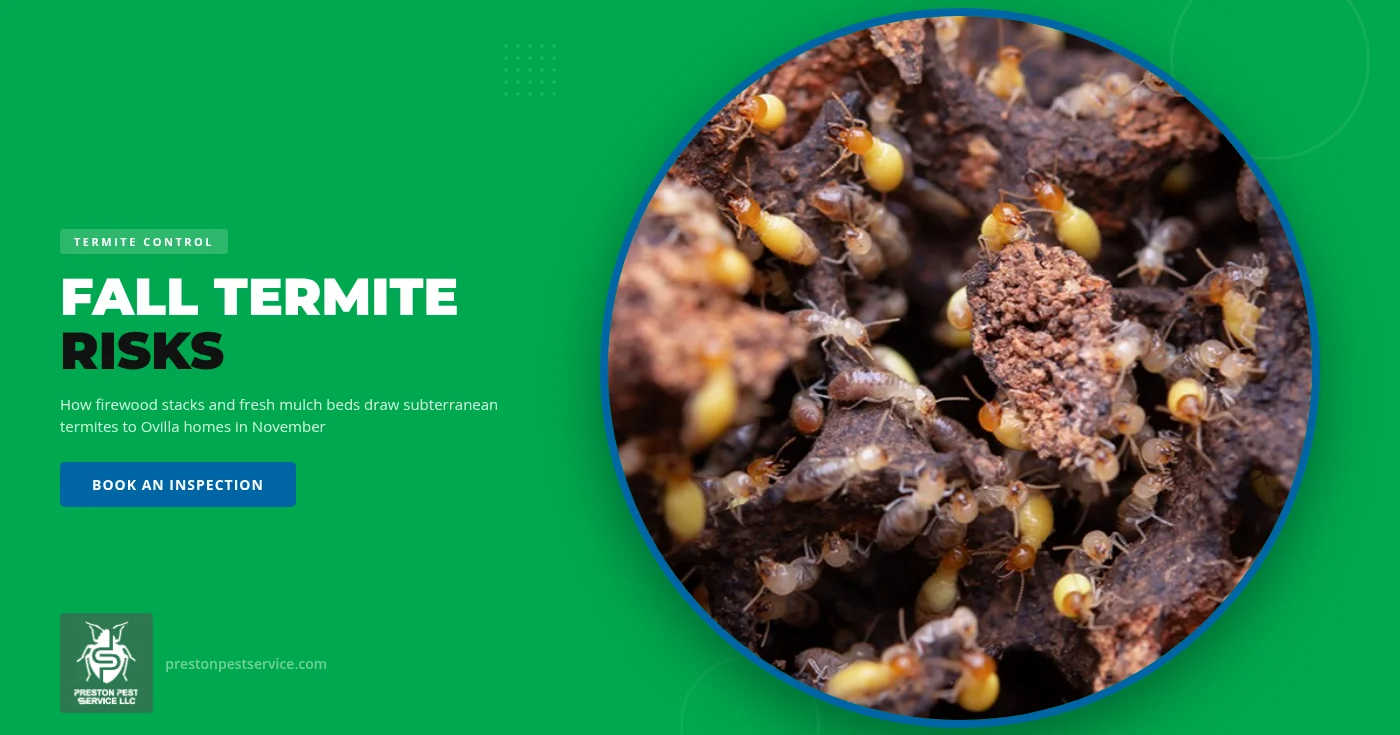
As the first cold fronts roll through, many homeowners stack a cord of oak by the back door and top off flower beds with fresh mulch. Both feel like smart fall chores, but they can quietly roll out the welcome mat for subterranean termites. If you’re researching termite control Ovilla TX options this November, those two habits are the best place to start.
Termites don’t take a holiday when the weather cools. Across Ellis County, mild days, damp clay soil and wooded lots give colonies every reason to keep foraging against your slab, out of sight.
Below, we explain why termites stay busy in late fall and how firewood and mulch create conducive conditions. We also cover which warning signs to watch for, the simple fixes that make your home less inviting, and when to call a professional.
Why Subterranean Termites Stay Active Through Ovilla’s Mild November
Most termite damage in our region comes from eastern subterranean termites and their close Reticulitermes relatives. According to Texas A&M AgriLife Extension, they live in the soil and need steady moisture to survive. They travel underground and build pencil-width mud tubes to cross surfaces they can’t tunnel through, such as a concrete foundation.
November around Dallas–Fort Worth typically brings highs in the 60s and lows in the 40s. The first freeze often arrives in mid-to-late November, though that varies from year to year. Cooler weather slows termites down, but it doesn’t send them into hibernation. Colonies simply work deeper in the soil, where it stays warmer and damper. That’s good news for subterranean termites in Ovilla and bad news for the homes around them.
A few local factors keep them going:
- Expansive clay soil. Heavy clay shrinks and cracks when it dries, then swells after rain, opening small gaps along the slab.
- Fall moisture. Autumn showers and lawn irrigation keep the soil near the foundation damp.
- Wooded lots. Mature trees, old stumps and fallen limbs on semi-rural properties can feed established colonies.
Swarming season doesn’t start until roughly February through April, so fall activity is quiet. There are no winged swarmers to tip you off, which is why November damage so often goes unnoticed.
How Firewood Stacks Become a Termite Bridge to Your Home
Picture a typical woodpile: split logs stacked directly on the soil and leaning against the brick near the back patio. To a termite colony, that’s ideal. The bottom layer sits on moist ground, the stack shades and dampens the soil, and the whole pile touches your house.
This part surprises many homeowners: termites in firewood rarely start a new colony indoors. Workers carried inside on a log have no queen and no soil moisture, so they usually die off. As entomologists at the University of Kentucky explain, the real risk is what the woodpile does outside. It feeds and shelters a colony that’s already living in the soil beside your foundation.
Once termites settle into a pile resting against the house, they’re inches from the slab edge, the weep holes in brick veneer, and any wood siding or trim. The stack also hides mud tubes, so termites can travel up behind the wood for weeks without anyone noticing.
Woodpiles attract more than termites. Stacked logs give mice and rats a dry, sheltered place to nest just as temperatures drop. That’s why firewood problems often overlap with rodent control calls this time of year.
Firewood isn’t the enemy, but where and how you store it matters a great deal.
Fresh Fall Mulch Beds, Moisture, and Termite Foraging Near the Foundation
Fall is a popular time to refresh landscape beds. Mulch holds moisture for plants, insulates roots and makes a home look finished. Unfortunately, those same qualities can make the soil along your foundation more appealing to termites.
With mulch and termites, the issue isn’t really food, because termites don’t appear to feed heavily on wood mulch. The bigger problem is what mulch creates underneath: consistently moist soil and stable temperatures, which are exactly what foraging workers look for. Pile it thick against the slab and you’ve built a damp, sheltered corridor to your house.
At Preston, the trouble spots we see most often include:
- Mulch heaped 4 inches deep or more that stays wet for days after rain
- Beds that bury the slab edge and hide any mud tubes
- Mulch or soil piled over brick weep holes or touching the bottom of the siding
- Sprinkler heads spraying directly onto beds beside the foundation
Cedar and cypress mulches are sometimes promoted as termite repellents. The evidence for that is limited, so we wouldn’t rely on them for protection. Rock and rubber mulch don’t break down into food, but they can still keep the soil damp underneath. Placement and depth matter more than the material you choose.
Warning Signs to Check for When You Bring Firewood Inside
Every trip to the woodpile is a chance for a quick check. It takes less than a minute and can catch a problem months earlier.
On the logs themselves, look for:
- Layered tunnels inside split wood, often lined with soil or a muddy material
- Small, pale, soft-bodied insects that scatter when exposed to light
- Wood that crumbles easily or sounds hollow when tapped
Where the pile sits, check for:
- Mud tubes running up the slab edge, the brick or the back of the stack
- Dark, damp soil that never seems to dry out
- Bubbling or blistered paint on nearby trim
Mud tubes on a slab foundation are usually brownish and about the width of a pencil. They may branch or run straight up the concrete. If you break one open and see creamy-white workers, the colony is active. Indoors, watch for soft baseboards or door frames. In spring especially, look for small piles of discarded wings near windows.
Don’t confuse termites with ants. Winged ants have pinched waists and elbowed antennae, while termites have thick, straight bodies and straight antennae. If ants are your issue, our ant control service can help.
Finally, bring in only as much wood as you’ll burn in a day or two, so hitchhiking insects don’t have time to wander.
Simple Fixes: Storing Firewood and Managing Mulch the Right Way
Most of these changes cost little and take an afternoon. Together, they remove the conditions that make your foundation attractive to termites.
Storing Firewood the Right Way
- Keep it away from the house. Extension guidance varies, with recommendations commonly ranging from about 5 to 20 feet. Farther is better if your yard allows.
- Raise it off the ground. A metal rack or concrete blocks keep the bottom layer dry.
- Cover the top only. A tarp on top sheds rain, while open sides let air circulate.
- Rotate your stock. Burn the oldest wood first, and don’t store firewood in the garage or on a porch against an exterior wall.
Managing Mulch Beds
- Keep mulch about 2–3 inches deep.
- Pull it back from the foundation; many experts suggest 6 to 12 inches.
- Leave roughly 6 inches of visible slab between the soil or mulch and your siding, so mud tubes are easy to spot.
- Keep weep holes clear, and aim sprinklers at plants, not the foundation.
Controlling Moisture
Clean the gutters after the leaves drop, extend downspouts away from the slab, and make sure the soil slopes away from the house. Removing old stumps and fallen limbs nearby takes away another food source.
When to Schedule a Professional Termite Inspection and Treatment
Good habits lower your risk, but they can’t tell you whether termites are already in the soil around your home. That’s where a professional termite inspection in Ovilla, TX comes in.
Consider scheduling one if:
- You’ve found mud tubes on the slab, the walls or the woodpile
- Firewood has been stacked against the house for a season or longer
- It’s been more than a year since your last inspection; annual checks are the common recommendation in North Texas
- You notice soft wood, blistered paint or discarded wings
Here at Preston, we start with a careful look at the exterior perimeter, the slab edge, the landscaping, any woodpiles and accessible areas inside. We look for active termites, damage and conducive conditions, then walk you through what we found.
If treatment is needed, there are two main professional options:
- Liquid soil treatments create a treated zone around the foundation.
- Baiting systems use bait that workers carry back to the colony.
Each option suits different homes and landscapes, and we’ll explain the trade-offs in plain language. In Texas, termite work must be done by licensed applicators regulated by the Texas Department of Agriculture’s Structural Pest Control Service. It’s always worth asking any provider about licensing.
Fall is a smart time to act. Termites are quieter now but still feeding, and finding them before spring swarms gives you a head start.
Frequently Asked Questions About Fall Termite Control in Ovilla, TX
Can firewood stacked against the house bring termites in Ovilla?
It can make an existing problem worse. Termites carried inside on logs rarely survive. But a woodpile resting against your home gives a soil colony moisture, food and cover right beside your foundation. Move it away and raise it off the ground.
Are termites still active in November in North Texas?
Yes. Subterranean termites slow down as the soil cools, but they don’t hibernate through our mild winters. They keep feeding underground, which is why fall damage is easy to miss.
How far should firewood be from the house to avoid termites?
Recommendations range from roughly 5 to 20 feet. We suggest keeping it as far away as is practical, raised off the ground and covered only on top.
Does mulch attract subterranean termites near the foundation?
Mulch isn’t much of a food source. However, it holds moisture and keeps soil temperatures steady, which encourages foraging. Keep it 2–3 inches deep and pulled back from the slab.
What do termite mud tubes look like on a slab foundation?
They’re brown, pencil-width tunnels made of soil, running up the concrete or brick. Break off a small section. If you see creamy-white insects inside, it’s time to call for an inspection.
Protect Your Home With Termite Control Ovilla TX Homeowners Can Rely On
Firewood and mulch are part of fall, and you don’t have to give them up. Move the woodpile, raise it off the ground, thin the mulch and keep the slab edge visible. Together, those steps go a long way toward fall termite prevention.
Here at Preston, we’re a local pest control team based in Venus. We serve neighbors across the southern Dallas area, including Midlothian, Maypearl, Alvarado, Grandview, Joshua and Glenn Heights. If you want termite control Ovilla TX residents can trust this season, contact us to schedule your termite inspection today.
Who Can Check My Home for Termites This Fall?
We’re Preston, a local pest control team based in Venus, and termites are one of the most common concerns we hear about from homeowners each fall. Subterranean termites work out of sight, so we focus on finding them early and on fixing the conditions that draw them in.
When you call us for termite control, here’s what you can expect:
- A thorough inspection of your slab edge, exterior walls, landscaping, woodpiles and accessible interior areas
- Clear explanations of what we found, including conducive conditions like firewood placement, mulch depth and moisture problems
- Treatment options, such as liquid soil treatments or baiting systems, matched to your home and yard
- Practical advice you can put to work right away to make your property less inviting
Termites are rarely the only pests that take advantage of fall changes. Woodpiles invite mice and rats, and shifting weather can push ants indoors. That’s why we also offer rodent control, ant control and full residential pest control, all built on an integrated pest management approach.
We proudly serve Venus and nearby communities, including Ovilla, Midlothian and Glenn Heights. Maybe you’ve spotted mud tubes, or maybe you simply want peace of mind before winter. Either way, reach out to our team and we’ll help you plan your next step.


