

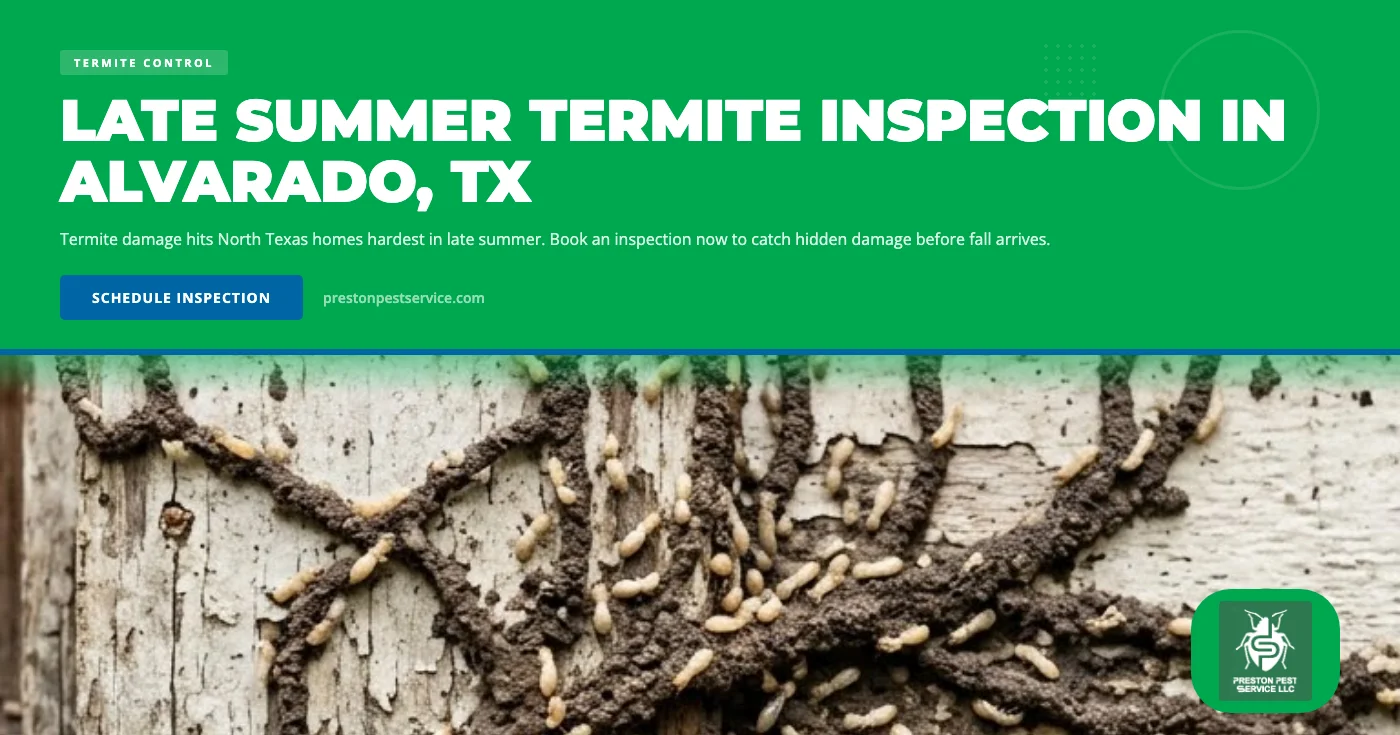
If you own a home in Alvarado, TX, late summer is one of the most important times of year to think about termites. By August, subterranean colonies that started building strength in the spring have grown into large, hungry populations feeding around the clock — often inside walls and foundations you never suspect. Scheduling a termite inspection Alvarado TX homeowners can trust before fall arrives is one of the smartest moves you can make, because catching activity now stops small problems from becoming five-figure repair bills.
We've treated homes across Johnson County long enough to know how this pattern plays out. Every September and October, we get panicked calls from homeowners who spotted mud tubes, buckled trim, or piles of tiny wings on a windowsill — and by then, the colony has usually been feeding for months. A professional inspection in late summer catches nearly all of these situations early and gives us time to treat before termites push deeper into your framing.
Why Late Summer Is Peak Time for Termite Damage in Alvarado, TX
Termites don't take the summer off — the opposite is true in North Texas. Eastern subterranean termites, by far the most common species in Johnson County, feed most aggressively from June through August when soil temperature and humidity sit in their sweet spot. Our clay-heavy soils hold moisture longer than sandier soils farther east, which gives underground colonies stable conditions to grow and forage well into September.
Damage also compounds fastest right now. A mature subterranean colony contains hundreds of thousands of workers, and those workers consume wood 24 hours a day. Because Alvarado sees mild winters, the ground rarely freezes deep enough to slow that pace — a colony discovered in August keeps feeding through fall and winter unless it's treated. Scheduling termite control in August or early September also means any treatment we recommend can be in place before the holidays, when the last thing anyone wants is a pest crew tearing into baseboards.
Warning Signs of an Active Termite Infestation in Texas Homes
Most Alvarado TX termite signs are subtle. Termites are quiet, they hide inside wood, and they leave very little visible evidence outside of a few telltale clues. Here's what we look for on every inspection — and what you can watch for between visits.
- Mud tubes. Pencil-thin tunnels of soil and saliva running up your foundation, pier posts, or crawl-space walls. Subterranean termites use these as a highway between the ground and the wood they're eating. Even an abandoned-looking tube is worth a professional look — colonies reroute rather than leave.
- Discarded wings. Late-spring and early-summer swarmers shed their wings in tidy piles near windows, sliding doors, and light fixtures. Small translucent wings on a sill in August usually mean a swarm happened earlier and survivors are nesting nearby.
- Frass. Drywood termites — less common but present here — push tiny wood-colored pellets out of small "kick-out" holes. Frass looks like coffee grounds or coarse sand and collects on windowsills, floors, or attic surfaces below infested wood.
- Hollow-sounding wood. Termites eat wood from the inside out, leaving a thin veneer. Tapping a baseboard, door frame, or exposed beam and hearing a papery, hollow tone is a strong hint that something is going on inside.
- Buckled paint or blistered drywall. Moisture from termite activity behind a wall often shows up as bubbling paint, sagging drywall, or trim pulling loose — damage that looks like water intrusion but has a very different cause.
- Sticking doors or windows. As termites tunnel through framing, warping can cause doors and windows to bind. If a door that opened fine in spring now scrapes the frame, it's worth checking.
Any one of these clues warrants a call. Two or more, and we'd strongly recommend a full inspection before you do any other repair work — patching drywall over an active colony just delays the real fix.
Areas of Your Home That Termites Target Most in August
When we walk an Alvarado property in late summer, we don't just wander looking for wings. We head straight to the places subterranean termites love — the spots where wood meets soil, where moisture collects, and where cracks give them an easy path inside.
Foundation perimeter. The first ten feet around your slab is prime territory. We look for mud tubes on exterior walls, at expansion joints, and where utility lines punch through the foundation. Any spot where mulch, soil, or landscaping timbers touch your siding is a shortcut.
Crawl spaces and pier-and-beam framing. If your home has a crawl space, this is the most vulnerable area. Warm, humid, dark, and full of untreated wood — the environment subterranean termites evolved for. We inspect every pier, sill plate, and floor joist.
Bath traps and utility penetrations. The gap around your tub drain, shower plumbing, and any pipe cutout through the slab is one of the most common termite entry points in North Texas homes. Builders often leave a bare-earth void here, and termites travel straight up.
Garages and attached workshops. Garages tend to have exposed framing, stored lumber, and door thresholds that touch soil. We check sole plates, door jambs, and any wood shelving anchored to the wall.
Attics. Drywood termites often show up in attic framing and eaves rather than at ground level. We look for frass under rafters, kick-out holes on decking, and wing piles near soffit vents.
What a Professional Termite Inspection Covers
A real termite inspection Alvarado TX homeowners can rely on takes time. We block off between an hour and two hours per home because the work has to be methodical — a quick walk-around misses the exact clues we're trying to find.
We start on the exterior, walking the entire foundation and looking for mud tubes, wood-to-soil contact, moisture damage on siding, and conducive conditions like heavy mulch beds, wood stacked against siding, or downspouts dumping water at the base of the foundation. We check exterior door frames, garage trim, deck posts, fence lines close to the home, and any wooden landscaping features touching the ground.
Inside, we work room by room. We tap baseboards, inspect window and door frames, and use moisture meters on walls and floors where damage hides. We open under-sink cabinets and check plumbing penetrations, and in bathrooms we pay close attention to tub surrounds and around toilets, where slow leaks create the exact damp conditions termites want. If your home has a crawl space, we suit up and get under it — every accessible sill plate, joist, pier, and subfloor surface. Attics get the same treatment.
When we're done, we sit down with you and walk through what we found. If we saw active termites, we'll show you where. If we didn't see activity but noticed conducive conditions, we'll flag those and give you practical steps to fix them. According to Texas A&M AgriLife Extension's subterranean termite resource, early detection through professional inspection is the single most effective way to prevent structural damage — the same principle drives how we run every visit.
How to Reduce Termite Risk Before Fall Arrives
An inspection is one half of the equation. The other half is making your home a less attractive target between visits. These are the exact steps we walk homeowners through after every inspection.
- Pull mulch and soil back from your foundation. Aim for at least a four-inch gap between organic material and your siding. Wood chips against a wall are a welcome mat.
- Fix leaks fast. Dripping faucets, leaking hose bibs, condensating AC lines, and clogged gutters all create the damp soil termites need. Even a slow drip can support an entire foraging column.
- Move firewood, lumber, and cardboard away from the house. Store wood at least 20 feet from the home and up off the ground on a rack.
- Grade soil away from the foundation. If low spots puddle after rain, fill them in and re-slope so water runs away from the house.
- Seal foundation cracks. Caulk and hydraulic cement work well for gaps at expansion joints, utility penetrations, and door thresholds under a quarter inch.
- Clear gutters and downspouts. A clean set of gutters routes water away from the highest-risk zone.
- Inspect wood decks, fences, and outbuildings. Any structure with wood-to-soil contact is a stepping stone for termites. Look for soft spots, mud tubes, or discarded wings on nearby structures during your own walk-around.
None of these steps replace an inspection or treatment, but together they can meaningfully reduce the pressure on your home and slow how quickly a colony can establish.
When to Call Preston Pest Service for Termite Treatment
If you've noticed any warning signs — mud tubes, discarded wings, frass, blistered paint, sticking doors — call us and get on the schedule this week. Termite damage in Alvarado, TX moves quickly in August, and even a two-week delay can mean noticeably more damage by the time we arrive.
We recommend a termite inspection every 12 months for every home in Johnson County, and every six months for homes with a history of activity, crawl spaces, or heavily wooded lots. If you're buying or selling a home, an inspection is essential before closing — repair costs after the fact almost always eat into any sale price you negotiated.
Our approach starts with the inspection, moves into a targeted treatment plan built around your home's construction and the species we identified, and finishes with ongoing monitoring so a re-infestation doesn't sneak up on you. We'll walk you through every option — liquid perimeter treatments, in-ground baiting systems, spot treatments for isolated activity — and explain why we're recommending what we recommend for your situation.
Reach out today to schedule your late-summer termite inspection Alvarado TX homeowners depend on. We'll get to your home fast, do the work thoroughly, and give you a straight read on whether treatment is needed — no scare tactics, just the facts.
Frequently Asked Questions About Termite Inspections in Alvarado, TX
How often should I have my Alvarado home inspected for termites?
We recommend an annual inspection for most homes in Johnson County. Homes with a prior termite history, crawl-space construction, or heavy tree cover around the foundation benefit from an inspection every six months. Late summer is a great time for the annual visit because activity is at its seasonal peak, which makes it easier for us to spot even low-level infestations.
Can I inspect for termites myself?
You can absolutely do your own walk-around and watch for the warning signs we listed above — that's a big help between professional visits. But a full inspection uses moisture meters, crawl-space access, and trained eyes on the exact spots termites hide, and Texas A&M AgriLife Extension recommends licensed professionals for the actual inspection because so much of what matters is invisible without the right training and tools.
Do termite treatments work in late summer?
Yes — often better than treatments applied earlier in the year, because we're catching colonies at their peak activity. Liquid perimeter treatments and in-ground bait systems both perform well in August and September heat, and the colonies are actively foraging, which means they encounter the treatment quickly.
What happens if I skip a termite inspection this year?
The colony keeps feeding. Subterranean termites in North Texas don't slow down enough over winter for missed inspections to be low-risk — every year without a check is another year of unmonitored activity. The nationwide average termite repair bill runs several thousand dollars, and severe cases can climb well into five figures, so skipping an inspection is almost always a false economy.
Is termite treatment disruptive to my family and pets?
Modern termite treatments are targeted and low-impact. Perimeter liquid treatments are applied outdoors along the foundation, and bait stations are small in-ground devices — most families don't need to leave the home during treatment. We'll walk you through everything before we start and give you clear guidance for any specific product we use.


