

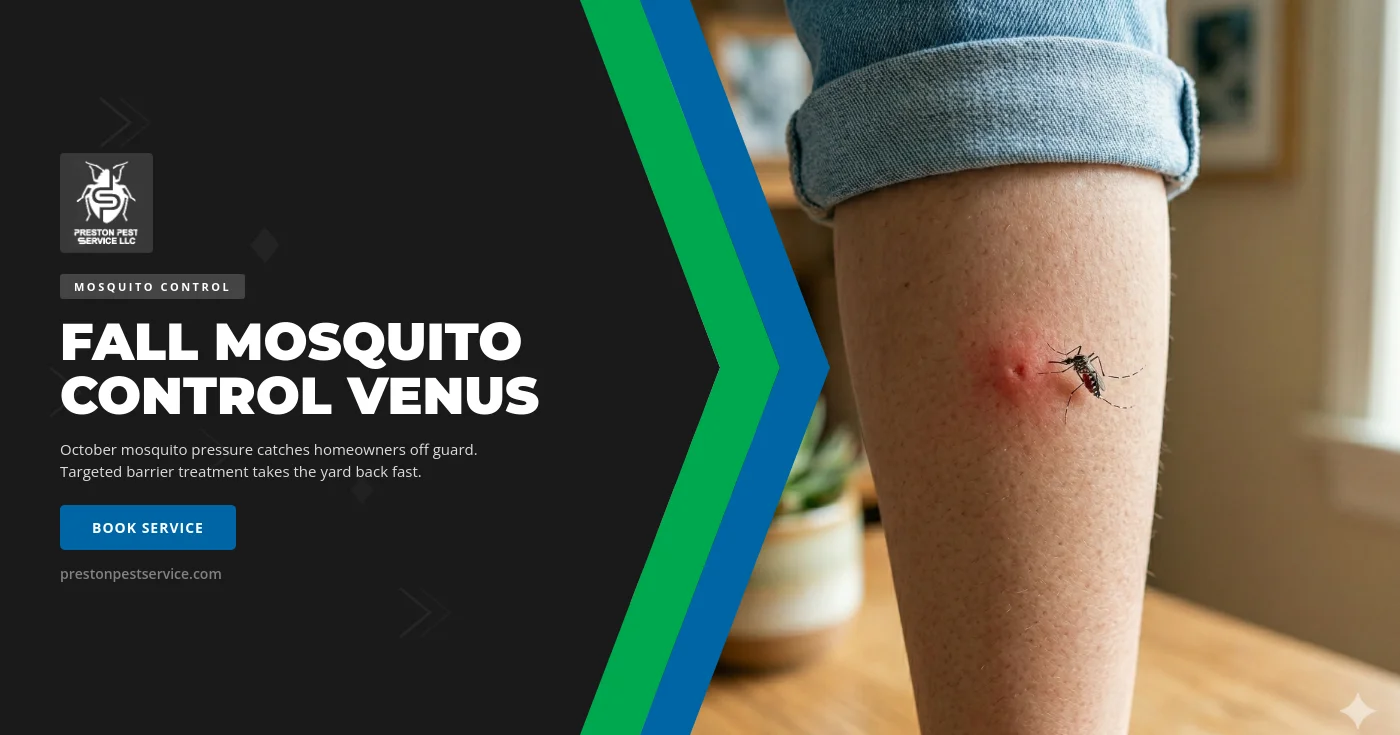
By late September, most Venus, TX homeowners think they are done with mosquitoes for the year. The patio is cooler, the evenings are shorter, and the triple-digit heat of August has broken — but the bites keep coming. Every October, we take calls from Johnson and Ellis County families surprised to find mosquitoes still swarming at dusk, still breeding in the back corner of the yard, and still forcing kids inside before the sun sets. The reality is simple: mosquito control Venus TX properties need in October looks different from the midsummer version, and skipping it is why so many yards stay unusable through the first cold front.
We have worked mosquito season across Johnson and Ellis counties long enough to know when the fall surge hits, where it hides, and why DIY tactics that worked in July start to fall short. This guide walks through the local biology behind late-season activity, the breeding sites most Venus homeowners miss, the health risks of a long North Texas mosquito season, and when to stop fighting the yard yourself.
Why Mosquitoes Don't Stop in October in Johnson County, TX
North Texas has a longer mosquito season than most of the country, and in Johnson and Ellis counties the biting window typically runs from March well into November. Our fall temperatures sit in exactly the range mosquitoes thrive in — daytime highs in the 70s and 80s, overnight lows that rarely dip below 50 until late October, and intermittent rainfall that leaves standing water sitting for days. Eggs laid in late summer continue to hatch, and shorter days slow evaporation, so breeding sites stay wet longer than in July.
The two genera we deal with most around Venus — Culex, the main carrier of West Nile virus in North Texas, and Aedes, the daytime-biting group that includes the Asian tiger mosquito — both stay active until nights consistently stay below about 50°F, and biting does not fully end until the first hard freeze. Around Venus, that cooldown typically arrives between late October and November. Everything between now and then is still mosquito season.
Common Breeding Spots Around Venus, TX Homes in the Fall
Fall breeding sites are sneakier than summer ones. By October, homeowners have drained the kiddie pools, put the hoses away, and stopped watering as often — which creates a false sense that the yard has fewer standing water sources than before. The opposite is often true, because cooler weather means water sits longer instead of evaporating by noon. According to Texas A&M AgriLife Extension, standing water that lingers as little as seven days produces a new generation of biting adults — and the Aedes species that cause most daytime biting live and bite within 200 to 300 yards of where they hatched. The mosquitoes bothering your family right now are almost certainly breeding on your property or your immediate neighbors'.
When we walk a Venus yard for fall breeding sites, these are the spots we check first:
- Potted plant saucers and patio pots. Fall irrigation habits often leave saucers topped off and ignored for weeks. One saucer can hatch a batch.
- Clogged gutters. Early leaf drop plugs gutter runs, trapping water right along the roofline. A clogged gutter is a breeding site directly above your head.
- Tarps, grill covers, and pool covers. Sagging covers hold surprisingly deep pockets of rainwater, and in October those pockets stay wet for weeks.
- Wheelbarrows, buckets, and kids' toys. Anything cupped that gets left out past September turns into a nursery.
- Low spots and tire ruts in the lawn. If a puddle is still wet three days after rain, it is holding long enough to matter.
- Birdbaths and pet water bowls. Weekly scrubbing — not just rinsing — is what dislodges eggs stuck to the sides.
- AC condensate drip lines. A steady drip of fresh water into mulch and gravel that gets overlooked every walkthrough.
- Ornamental ponds and rain barrels. If they cannot be drained, use a Bti (Bacillus thuringiensis israelensis) dunk or briquette, which targets mosquito larvae without harming fish or pollinators.
Walking the yard once a week with a flashlight and tipping out everything cupped is the highest-leverage move a homeowner can make.
Health Risks From Late-Season Mosquitoes in North Texas
October pressure is not only a nuisance problem. Local public health departments extend West Nile virus surveillance well past Labor Day because fall transmission is a documented pattern across North Texas. Texas reports human West Nile cases in most years, and the CDC's current-year surveillance data continues to show positive mosquito samples in multiple Texas counties through the fall.
West Nile is transmitted primarily by Culex mosquitoes that pick up the virus from infected birds, then pass it to people during dusk and dawn feedings. Most human infections cause no symptoms or mild flu-like illness, but a small percentage become serious neurological cases — and because there is no vaccine and no specific treatment, prevention is the only lever we actually control. Alongside West Nile, our fall mosquito mix can also carry St. Louis encephalitis. Layered mosquito control Venus TX families can rely on means reducing breeding sites, treating the resting areas where adult mosquitoes shelter during the day, and using EPA-registered repellents on exposed skin.
Kids, older family members, and anyone with a weakened immune system are most likely to see serious outcomes from a mosquito-borne illness — worth keeping in mind in October, when the perception that the season is over drops household vigilance right when transmission risk is still real.
DIY Mosquito Reduction Tips That Actually Work in Venus
Before we recommend professional service, we ask homeowners to run the yard through this weekly routine. The whole point is to deprive mosquitoes of the water they need to reproduce:
- Walk the property once a week with a flashlight and tip out every container holding water — plant saucers, buckets, wheelbarrows, kids' toys, pet dishes.
- Clean leaves out of gutters and downspouts after every heavy wind or storm. A clogged gutter in October drains into a breeding pocket.
- Shake water off tarps, grill covers, and pool covers after each rain. If a cover sags enough to hold water, retension it or replace it.
- Fill in tire ruts and low spots with soil or sand so puddles do not persist.
- Trim ivy, dense shrubs, and tall grass at the yard edges, where adult mosquitoes rest during the day.
- Change water in birdbaths at least weekly, and scrub the sides to dislodge eggs.
- For ornamental ponds, rain barrels, and bog gardens that cannot be drained, use Bti briquettes or dunks — they kill mosquito larvae for up to 30 days and are gentle around pets, pollinators, and fish.
- Patch holes in window and door screens before cool-weather windows get left open overnight.
- Use an EPA-registered repellent on skin when you are outside at dawn, dusk, or in shaded areas during the day.
Most Venus homes have more containers holding water than homeowners realize — we frequently find eight to twelve breeding sites on yards the owner swore were empty.
When Professional Mosquito Treatment Makes Sense
Not every yard needs a scheduled program. If you are getting occasional bites and your weekly walkthrough is keeping breeding sites down, DIY vigilance is often enough. The calculus shifts when the yard is actively costing you something — missed cookouts, bitten kids and pets, canceled plans, or a persistent biting pattern that will not drop off no matter how disciplined your routine is.
Signs a Venus property is past the DIY stage:
- You have drained every container you can find and the biting has not noticeably dropped off within two weeks.
- Kids and pets are getting bitten in shaded parts of the yard before dusk — a classic Aedes daytime pattern.
- You back up to a creek, drainage easement, retention pond, or an unmaintained lot. Breeding pressure from off your property can overwhelm even a well-maintained yard.
- Someone in the home has an immune concern or allergy history that makes bite reactions worse.
- Your property is more than a quarter acre and you cannot realistically walk every drainage edge weekly.
Any one of those is a reasonable reason to bring in a professional team. When several are true at once, scheduled mosquito control Venus TX service outperforms even the most dedicated homeowner routine, because professional barrier treatment reaches the resting areas and larval sites that a weekly walkthrough never will.
How Preston Pest Service Treats Mosquitoes in Venus, TX
Our approach to mosquito control in Venus is built as a season-long partnership rather than a one-off spray. When a Venus family signs on, we begin with a full property walk to map breeding sites, resting areas, and pressure sources from neighboring lots or drainage features. From that walk we build a recurring schedule — typically every 21 to 30 days from spring through fall — combining targeted barrier applications on the shaded undersides of foliage, fencing, and mulch beds, and larvicide treatment at any standing water sources that cannot be removed.
Because our team is based right here in Venus, we can usually be on-site within a day or two of a call, and we are happy to return between scheduled visits after a heavy storm or ahead of a backyard event. Mosquito control Venus TX homeowners can rely on through October and into November looks like consistent coverage, well-timed applications, and a team that knows which neighborhoods back up to the drainage features and pasture ponds that keep pumping out new generations. If you have been fighting bites all fall, visit Preston Pest Service to get in touch and we will walk the property with you.
Frequently Asked Questions About Mosquito Control in Venus, TX
When does mosquito season actually end in Johnson County, TX?
Mosquito activity around Venus slows sharply once overnight temperatures stay below about 50°F — typically late October into November — and ends with the first hard freeze. Until then, October is still mosquito season, and warm snaps can push biting activity later in mild years.
Why am I getting bitten in October when summer is over?
Fall temperatures in North Texas sit right in the range mosquitoes thrive in, and shorter days mean standing water stays wet longer. Eggs laid in late summer are still hatching, and the generation feeding on your family right now was probably born in a plant saucer or clogged gutter within 200 to 300 yards of your yard.
Does cold weather kill mosquitoes immediately?
No. Activity slows sharply once nights stay below about 50°F. A single cool evening slows them down briefly, but they bounce back as soon as the next warm stretch arrives. The first hard freeze is what ends the biting season, and around Venus that usually comes after Halloween.
Is professional mosquito treatment gentle around pets and kids?
The products we use are EPA-registered and applied in targeted zones — the shaded undersides of foliage, fencing, and mulch beds where adult mosquitoes rest, plus standing water sources that get Bti larvicide. We let homeowners know how long to keep pets and children off treated surfaces, and once the product has dried, treated areas are gentle for family use. For ponds and water features, we use Bti products because they target mosquito larvae without harming fish or pollinators.
How often does my yard need treatment during the fall?
Our recurring Venus service is typically every 21 to 30 days — the window where residual barrier products hold up well in North Texas conditions. Between visits, we return after a heavy storm or before a specific event. Most properties see a noticeable reduction in biting within one or two treatment cycles.


