

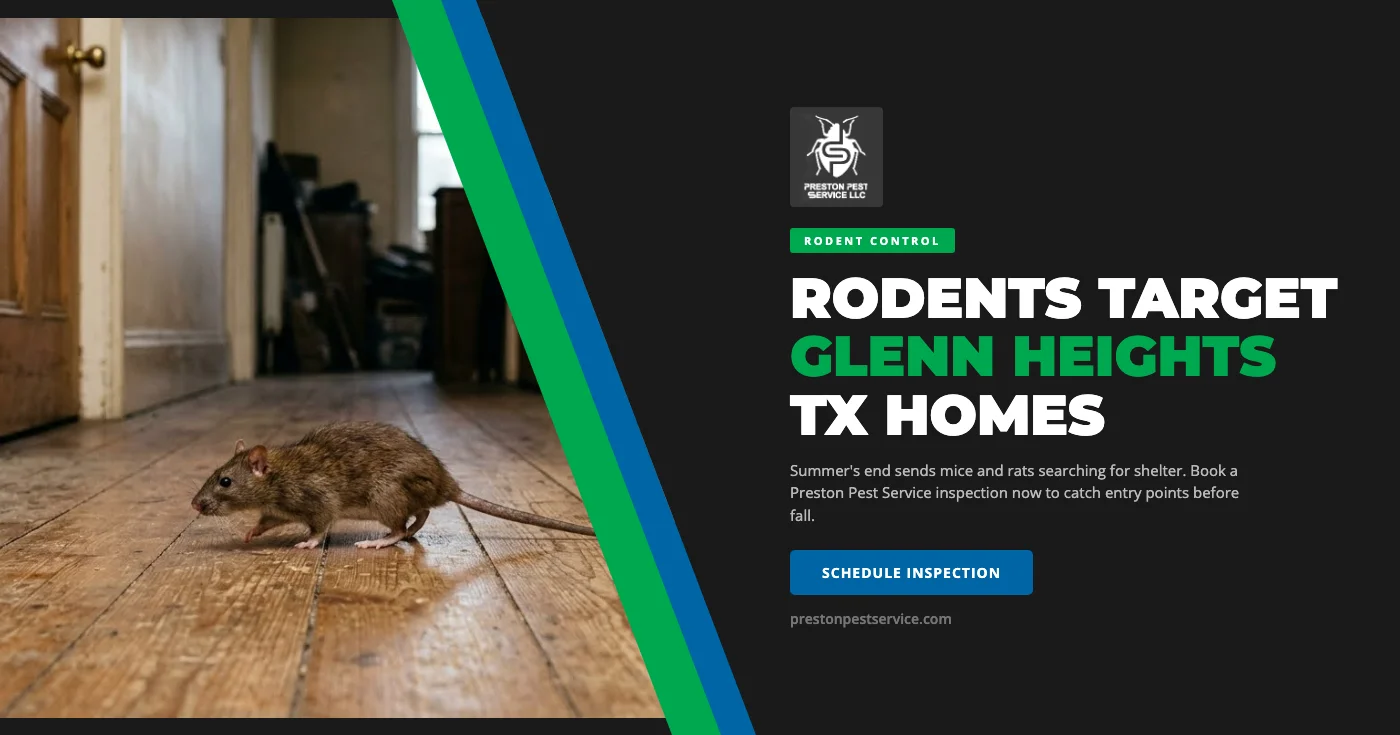
Every year around this time, the phone starts ringing with the same story: a Glenn Heights homeowner heard scratching in the attic overnight, spotted droppings in the pantry, or noticed the dog fixated on a spot behind the fridge. Late summer is when rodents in North Texas quietly transition from outdoor foraging to indoor nesting, and by the time most people notice, a handful of animals has already claimed the warmest, quietest spots in the house. Getting ahead of that with proper rodent control Glenn Heights TX homeowners can trust is the difference between a quick, targeted fix and a full-blown infestation by Thanksgiving.
Why Late Summer Is When Rodents Start Moving Into Glenn Heights, TX Homes
Rodents don't wait for the first cold front to head indoors. They move on temperature, water, and food, and by August all three conditions push them toward houses. Glenn Heights sits in a humid subtropical zone where late-summer highs regularly climb into the upper 90s, and the ground bakes hard enough to close the burrows rodents relied on all spring. That heat, plus a typical dry spell, wipes out the puddles and irrigation runoff that had been keeping populations hydrated in vacant lots and greenbelts.
Homes solve every one of those problems at once. An air-conditioned interior sits 25 to 40 degrees cooler than the yard. Sprinkler systems, AC condensate lines, and leaky hose bibs are steady water sources, and kitchens and pantries offer reliable calories. Outdoor populations have also been reproducing since March, so by late August a much larger group is competing for shrinking outdoor resources. Because North Texas winters are mild and short, colonies that establish in September rarely get knocked back — what starts as two mice behind an oven in early fall can be twenty by January. That's why the honest answer to "when do mice start invading homes in Texas" is late summer, quietly — not October or November when most homeowners start thinking about it.
Common Rodents in Glenn Heights and the Greater Ellis County Area
Matching the treatment to the species is a big part of what makes a rodent plan actually work. Around Glenn Heights and the broader south Dallas area, four species account for nearly every call.
- House mice. The most common rodent we find inside Glenn Heights homes. Small, tan-brown, and capable of squeezing through a hole the size of a dime. They nest in walls, behind appliances, and in stored boxes — and they're the species most likely to show up in kitchens and pantries.
- Roof rats. Slender, dark, and excellent climbers. Roof rats move along fence tops, tree branches, and utility lines, and they enter homes at the roofline through gable vents, soffit gaps, and chimney caps. In Glenn Heights we find them most in attics, especially in neighborhoods with mature trees close to the house.
- Norway rats. Larger and stockier than roof rats and closer to the ground. They burrow under slabs, sheds, and woodpiles and enter through foundation cracks, garage door corners, and utility penetrations near grade. Activity picks up along drainage easements and near commercial properties.
- Field mice and pack rats. Frequent in garages, sheds, and detached workshops on the more rural edges of Ellis County. Both chew wiring, insulation, and stored belongings once established.
Each species needs different exclusion materials, trap placements, and follow-up — which is why we start every rodent job with a thorough inspection instead of jumping straight to bait.
Warning Signs of a Rodent Infestation Every Homeowner Should Know
Most signs of rodent infestation Glenn Heights TX homeowners describe over the phone are things they noticed but didn't think much of at first. Here's what to watch for, and what each clue usually means.
- Droppings. Mouse droppings are dark, dry, and rice-grain sized — along walls, in drawers, behind pantry cans, and under sinks. Rat droppings are larger, roughly raisin-sized, and cluster near nesting sites and food.
- Scratching or scurrying at night. Rodents are most active between dusk and a few hours after sunrise. Scratching in the attic around 10 p.m. usually means roof rats; faster, lighter scampering inside a wall points to mice.
- Grease marks and rub trails. Rodents follow the same paths repeatedly, and the oil in their fur leaves dark smudges along baseboards, pipe cutouts, and stud tops.
- Gnaw marks and nesting material. Fresh gnawing shows lighter-colored wood under the surface — common on pantry packaging, door jambs, and soffit corners. Shredded paper, insulation, dryer lint, or dog hair tucked into a quiet corner is almost always a nest.
- Musky odor. A sharp, ammonia-tinged smell in a cabinet, closet, or attic is rodent urine soaking into insulation or wood — often the last clue people notice, and it usually means the population has been present for weeks.
- Pet behavior. Dogs and cats often notice rodents long before their owners do. A dog fixated on a wall or refrigerator base is worth taking seriously.
Any single clue warrants a look; two or more, and it's time for a professional inspection before the population expands.
How Rodents Get Inside: Entry Points Around Your Glenn Heights Home
Rodents don't chew a random hole through the middle of a wall — they exploit gaps that already exist. Understanding where those gaps are is the entire game when it comes to keeping mice out of your house in Glenn Heights, Texas.
Utility and pipe penetrations. Every plumbing line, gas line, AC lineset, electrical conduit, and cable enters the house through a hole in the exterior wall or slab — nine times out of ten, over-drilled and never fully sealed. The gap around a bath trap, a hose bib, or the freon lines behind the AC condenser is the single most common entry point we find in North Texas homes.
Garage door corners and door thresholds. The rubber seal at the bottom of a garage door wears out, and the lower corners almost always develop a small triangular gap. A mouse needs a quarter-inch; a rat needs half an inch. Front, back, and patio doors have the same problem — a dollar-bill test (slide a bill under the closed door and try to pull it out) tells you fast whether the seal is doing its job.
Vents and rooflines. Standard gable, soffit, and dryer vent screens are designed for airflow, not rodent exclusion. Roof rats and squirrels routinely pull screens loose or chew through plastic dryer-vent louvers. Missing or hail-damaged chimney caps are another obvious entry, and gaps at soffit and fascia joints open up over time as wood expands and contracts.
Foundation cracks and landscaping. Ellis County's expansive clay soils move a lot, and hairline slab cracks widen every dry summer — anything wider than a pencil is a Norway rat's on-ramp. Tree branches touching the roof, ivy on siding, and shrubs planted against the foundation all give rodents cover and easy access. We recommend a two-foot cleared strip around the foundation and no branches within six feet of the roofline.
DIY Rodent Prevention vs. Professional Rodent Control in Texas
Homeowner efforts are worth doing, and they meaningfully slow how quickly a rodent problem can escalate. But there's a real ceiling on what a set of snap traps and a can of foam sealant can accomplish, and understanding where that ceiling sits will save you a lot of frustration.
DIY steps that consistently pay off are prevention-focused: storing pantry items in glass or hard-plastic containers, keeping pet food off the floor in sealed bins, taking the trash out nightly during a suspected infestation, and reducing outdoor food sources like fallen birdseed. Weather-sealing doors, replacing torn dryer-vent covers, and pulling mulch back at least four inches from the foundation all reduce the physical opportunity to get in. Texas A&M AgriLife Extension's guidance on managing rats and mice lists exclusion and sanitation as the two most effective long-term controls, and we agree — those steps do more good than any trap or bait.
Where DIY runs into trouble is identification, exclusion of hard-to-reach entry points, and population reduction once rodents are established. Snap traps catch a few animals but rarely break a population — the survivors learn to avoid them. Grocery-store bait blocks can move rodents into wall cavities where they die and stink for weeks. Foam sealant is a food source on its own; rodents chew through it unless it's backed with copper mesh or hardware cloth. Professional rat control Ellis County Texas homeowners can rely on brings three things a hardware-store kit can't: correct species identification, rodent-rated exclusion at every entry point, and a follow-up cadence that catches the survivors.
How Preston Pest Service Protects Glenn Heights Homes from Rodents
Our rodent process is built around how rodents actually behave in North Texas homes. Every job starts with a full inspection — walking the foundation, checking utility penetrations, inspecting the roofline, examining garage doors and exterior thresholds, and noting landscaping issues. Inside, we check attics, garages, pantries, under-sink cabinets, and any room where you've heard activity, then identify the species from droppings, grease marks, nesting material, and (where present) the animals themselves.
Once we know what we're dealing with, we build a rodent control plan that combines exclusion, targeted trapping, and follow-up. Exclusion uses rodent-rated materials — hardware cloth backed with sealant, copper mesh, sheet metal, and pest-control-rated door sweeps — installed at every entry point we identified. Trapping uses snap traps and, where appropriate, tamper-resistant bait stations placed along established runways. Follow-up visits happen at intervals matched to the species and population size, and we don't consider a job finished until two consecutive visits show zero new activity.
Our team has served Glenn Heights, Ovilla, Red Oak, DeSoto, Venus, Midlothian, Grandview, Alvarado, and surrounding Ellis, Dallas, and Johnson County communities for years, with a 5.0-star rating across more than 200 reviews. If you've noticed any warning signs above, reach out today for a rodent exterminator Glenn Heights Texas homeowners consistently recommend. Late summer is the window to get rodent control Glenn Heights TX homes need in place before the population doubles again in the fall.
Frequently Asked Questions About Rodent Control in Glenn Heights, TX
How can I tell if I have mice or rats in my Glenn Heights home?
Droppings are the fastest tell — mouse droppings are rice-grain sized and dark; rat droppings are closer to raisin-sized. Sound gives it away too: light scampering in walls usually means mice, while heavier scratching in the attic points to rats. If you're not sure, a quick inspection confirms the species and extent.
When do mice start invading homes in Texas?
The migration indoors begins in late July and August, quietly, as outdoor heat and drought reduce food and water sources. Most homeowners don't notice until October or November because the population is small early on. Catching it in August or September is the difference between two or three mice and a colony of twenty by winter.
How do I keep mice out of my house in Glenn Heights, Texas?
Seal every gap wider than a pencil (especially at utility penetrations, garage door corners, and door thresholds), remove indoor and outdoor food sources, and pull vegetation and mulch back from the foundation. For a real long-term fix, add a professional inspection that identifies every entry point and installs rodent-rated exclusion materials.
Are DIY rodent traps enough to solve an infestation?
Traps help but rarely solve it alone. They catch a portion of the population, the survivors learn to avoid them, and without sealing entry points, new rodents replace the ones you caught within weeks. Combining trapping with exclusion is what actually breaks a population.
Do rodents cause damage beyond being a nuisance?
Yes — and this is often what finally prompts the call. Rodents chew wiring (a documented cause of house fires), insulation, HVAC ducts, and stored belongings, and they contaminate pantry food and food-prep surfaces with droppings and urine. Rodent urine can soak into attic insulation deeply enough that replacement is the only real fix. The longer a population is present, the more expensive the eventual cleanup.


