

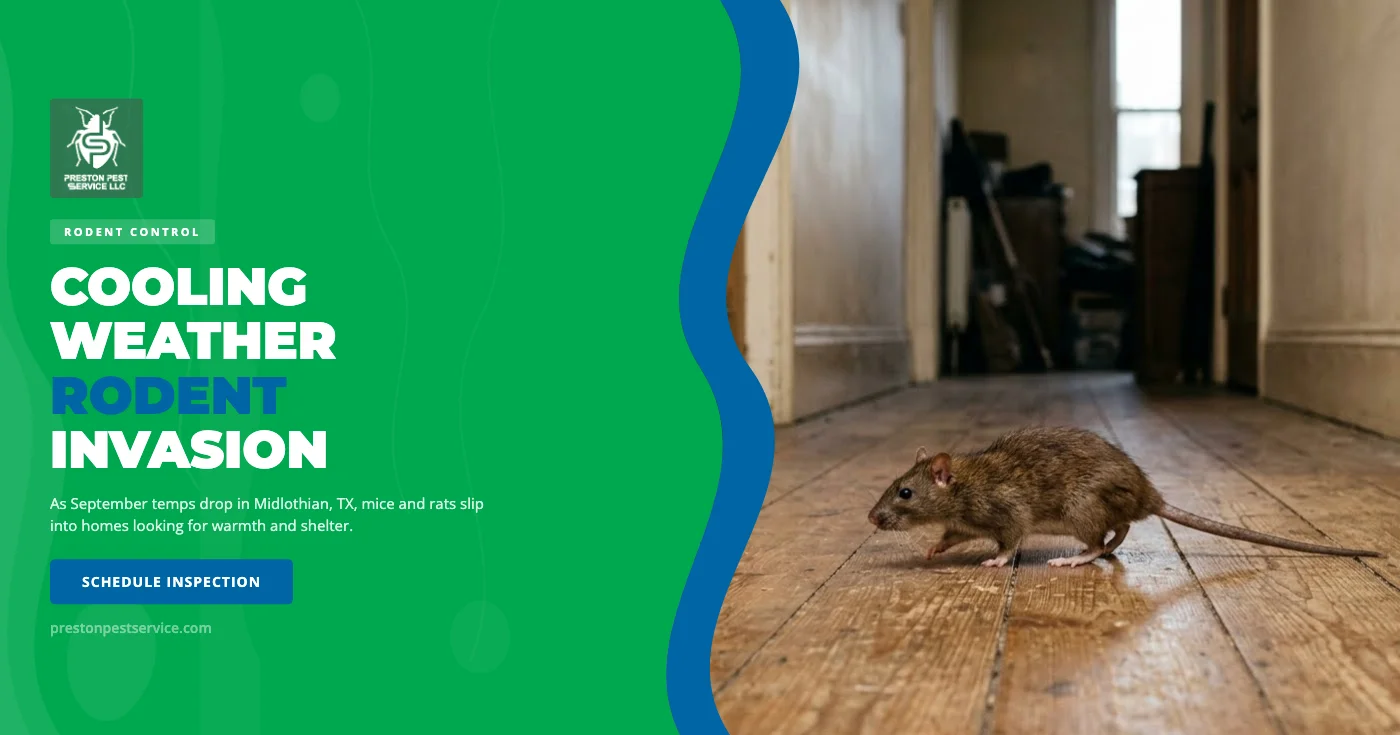
If you own a home in Midlothian, TX, September is when rats and mice stop being an occasional yard visitor and start becoming an indoor problem. Nighttime lows dip into the 60s, the first cold fronts push down from the plains, and the seed heads and insect populations outdoor rodents have been living on become less predictable. Your attic, garage, and pantry suddenly look a lot more appealing. Reliable rodent control Midlothian TX homeowners can count on has to account for that seasonal shift, and early fall is the window when getting ahead of the pressure matters most.
We've treated rodent problems across Ellis County long enough to know how fast a couple of pellets in a garage corner turn into a full attic infestation. A single female house mouse can produce five to ten litters a year, and a pair of roof rats can seed a colony in a season. Catching activity in September makes every treatment work harder.
Why September Cooling Temperatures Drive Rodents Into Midlothian, TX Homes
Rodents respond to three drivers above almost everything else: temperature, food availability, and shelter. Through the summer, all three are easy to find outdoors in North Texas — field crops, seed heads, and shaded harborage under woodpiles support a large outdoor population without much of it coming near a house. Once September arrives, that equation flips. Cold fronts strip green cover off pasture edges, insect activity collapses, and every one of those shifts nudges rats and mice toward whatever stable, warm, food-rich environment is nearby. In a Midlothian subdivision, the nearest option is almost always a home.
Fall also lines up with reproductive timing. A house mouse whose litter is born in September can have grandchildren by Thanksgiving, and roof rats hit peak breeding pressure through fall and early winter. The homeowners we hear from in November and December are almost always dealing with populations that first pushed inside in September — which is why the fall rodent prevention Midlothian TX pros recommend starts well before the first freeze.
Common Rodent Species Found in Ellis County, Texas
Treatment plans aren't one-size-fits-all. Knowing which rodent we're dealing with tells us where to inspect, what bait strategy to use, and what exclusion work will keep them from coming back.
House mouse (Mus musculus). The most common indoor rodent in North Texas — three to four inches of body, grayish-brown, capable of squeezing through a gap the size of a dime. House mice breed year-round once they've found harborage and prefer to nest close to a food source. Kitchens, pantries, and utility closets are their favorite indoor territory.
Roof rat (Rattus rattus). Sleek, dark rats about six to eight inches in body length with a tail longer than the body. Roof rats are strong climbers that prefer elevated harborage — attics, soffits, and utility lines. In Midlothian's older neighborhoods with mature oaks and pecans, they travel across tree limbs and power lines to reach roof edges, then work inside through soffit gaps and vent penetrations.
Norway rat (Rattus norvegicus). Bulkier and browner than roof rats, with a tail shorter than the body. Norway rats stay closer to ground level — burrows along foundations, creek edges, and under sheds and slabs — and enter through garage-door gaps and low utility penetrations.
Deer mouse and white-footed mouse. On the rural edge of Ellis County — properties with pasture, brush lines, and outbuildings — we occasionally see native field mice moving into garages and sheds in the fall. Both species are the primary carriers of hantavirus in North America, according to the Centers for Disease Control and Prevention, which is one reason we treat rural rodent control Midlothian TX calls differently than suburban ones.
How Rodents Enter Your Midlothian Home — and Where They Hide
Every species has its favorite way in. Knowing those routes tells us where to inspect and where to help you seal.
Garage doors and ground-level gaps. The rubber sweep at the bottom of a garage door is one of the top three rodent entry points on almost every home we service. As the sweep ages, it hardens, cracks, and gaps at the corners. Weep holes on brick homes and utility penetrations for cable, plumbing, and gas lines are the other two — every one of them widens as the sealant ages.
Soffit and roofline gaps. Roof rats prefer these. Soffit vents, dryer vent hoods, roof-flashing seams, and the corners where fascia meets soffit all offer entry to a warm attic. Once inside, roof rats travel along top plates and can drop into wall voids anywhere in the home. Tree limbs that touch a roof edge become highways; cable and utility lines make bridges. We spend a lot of time on ladders during Midlothian inspections because most of the meaningful roof-rat exclusion happens at eave level.
Indoor harborage. Once inside, house mice gravitate to warm spaces close to food — behind refrigerators, in stove drawers, inside pantry corners, and along cabinet toe kicks. Roof rats stay upstairs in the attic and travel down through wall voids at night to forage.
Health and Property Risks of a Rodent Infestation
A few pellets in a garage corner sound like a minor issue. What sits behind them usually is not.
Disease risk. Rats and mice carry a long list of pathogens. The CDC's rodent-control guidance outlines transmission risk from hantavirus, leptospirosis, salmonellosis, and lymphocytic choriomeningitis — most of which spread through contact with urine, droppings, or contaminated food surfaces. Cleaning an attic contaminated with rodent droppings without proper PPE is one of the higher-risk homeowner activities we see.
Wiring, insulation, and food damage. Rodent incisors never stop growing, so they never stop chewing. Attic wiring, HVAC line insulation, and low-voltage cables are common casualties, and chewed wiring is a documented fire hazard. A roof rat colony in an attic will urinate throughout the insulation and compress large sections into nesting, and contaminated blown-in insulation loses R-value and has to be replaced. A single mouse can contaminate ten times more food than it eats, according to Texas A&M AgriLife Extension.
Early Warning Signs You Have a Rodent Problem
Rodents are nocturnal, cautious, and much smaller than the space they occupy. By the time you see one during the day, the colony has been building for a while. Most of these clues show up long before the rodents themselves do.
- Droppings. Mouse droppings are dark, pointed, and about the size of a grain of rice. Rat droppings are larger — pellet-sized to raisin-sized — often in linear clusters along beams or in garage corners.
- Gnaw marks. Fresh gnaw marks on wood trim, pantry packaging, or the corners of cardboard storage boxes show up as pale, splintered notches. Older marks darken as they age.
- Rub marks. Rats leave dark, greasy smudges along walls, beams, and pipes where they travel repeatedly.
- Sounds at night. Scratching, scampering, or gnawing from the attic or wall voids after sunset — especially between 9 p.m. and midnight, when rodent activity peaks — almost always indicates an active infestation.
- Nesting material. Shredded paper, fabric scraps, and chewed insulation inside a garage, shed, or attic corner mean an active nest is nearby.
- Odor. A musky, ammonia-like smell in a pantry, closet, or attic corner indicates an established colony.
- Pet behavior. Sudden fixation on a wall, a specific cabinet, or a corner of the ceiling is worth checking out.
Any single sign is worth a call. Two or more, and we'd strongly recommend an inspection before setting out store-bought traps — hitting an active roof-rat colony with the wrong tools scatters the population deeper and makes it slower and more expensive to eliminate.
How Preston Pest Service Eliminates Rodent Infestations in Midlothian
Our approach to rodent control starts with a full inspection, not a trap you found in aisle six. We want to know which species we're dealing with, where they're nesting, how they're getting inside, and what's drawing them in. Every rodent job we run in Midlothian follows the same three-part structure: knock down the current population, seal the entry points, and put a monitoring program in place so we catch the next round of pressure early.
Population reduction. Depending on species, harborage, and severity, we combine tamper-resistant bait stations positioned along known travel routes with professional-grade snap trapping in attics and interior spaces. Every product goes into a locked station or a hidden interior placement — no loose bait, no accessible traps.
Exclusion work. This is where most DIY efforts fall short. We inspect the exterior from foundation to roofline and identify every gap, weep hole, penetration, and worn seal that could be a rodent entry point. Some fixes we handle directly; others we flag for a handyman. Either way, you leave the treatment cycle with a written list of every entry point on the home. Skipping exclusion means paying us to trap the same rodents twice.
Monitoring and follow-up. We schedule follow-up visits to verify the population is gone, check bait stations, and reset exterior monitoring that helps us catch new intrusion early. For homes backing pasture, greenbelt, or open drainage, we frequently recommend quarterly service so no fall rodent push gets a foothold indoors. Most house-mouse jobs resolve within three to four weeks; attic roof-rat work typically runs five to eight weeks depending on how established the colony is.
If you've been hearing sounds in the attic, spotting pellets in a garage corner, or catching a musky smell near a pantry, reach out today to schedule your rodent control Midlothian TX inspection. Fall is when Ellis County rodent pressure peaks, and every week you get ahead of it is a week the population isn't compounding inside your walls.
Frequently Asked Questions About Rodent Control in Midlothian, TX
Why are rodents getting into my Midlothian, Texas home in fall?
Cooling September nights, shorter days, and the collapse of outdoor food sources all push North Texas rodents toward warm, food-rich indoor spaces. Attics, garages, pantries, and utility rooms offer the temperature stability, food access, and shelter that outdoor habitat stops providing in early fall. Every gap, weep hole, or worn door sweep becomes a shortcut inside.
How can I stop rats and mice from entering my house in Midlothian, TX?
Effective pest control rodents Midlothian Texas homeowners rely on combines three things: sealing physical entry points, removing what attracts them, and monitoring for early activity. Exterior work matters most — replacing worn garage-door sweeps, sealing weep holes and utility penetrations, screening soffit vents, and trimming tree limbs away from the roof line. Indoors, store pet food and birdseed in sealed containers and pull up bird feeders that spill onto the ground.
What's the difference between a rat exterminator and a general pest control service?
A general pest program handles insects on a scheduled cadence. A rat exterminator Midlothian Texas homeowners hire for rodent-specific work brings species identification, exclusion inspection, tamper-resistant bait station placement, attic trapping, and sanitation experience to the job. The two services complement each other — a lot of our customers add rodent monitoring to an existing general pest program in the fall.
Are professional rodent treatments a concern around pets and kids?
Modern rodent programs are built around tamper-resistant bait stations, hidden interior traps, and targeted exclusion — not loose bait or open snap traps. Every product placement takes pets and children into account before it goes in. Compared with over-the-counter rodenticide pellets scattered along a baseboard, a professionally installed program puts the active ingredient behind a locked barrier that only the target rodent can access.
How long does mouse control in Ellis County TX typically take?
Mouse control Ellis County TX homeowners hire us for usually resolves within three to four weeks of the initial treatment when exclusion is done alongside the trapping. Roof-rat attic infestations take longer — usually five to eight weeks — because attic access, sanitation, and insulation work extend the job. Follow-up inspections verify the population is fully gone before we close out.


